A Publication of North Fork Audubon Society, Inc
As we say goodbye to the long, sunny days of summer and welcome the crisp air and changing colors of fall, we’re excited to share the latest news and happenings from North Fork Audubon Society.
In this issue we take a closer look at our headquarters at Inlet Pond County Park, learn more about the initiatives we’re taking part in, including Moore’s Woods and discover different ways NFAS continues to connect people with nature and protect the places and wildlife we love.
The Great Horned Owl - Tiger of the Sky
by Carol Edwards
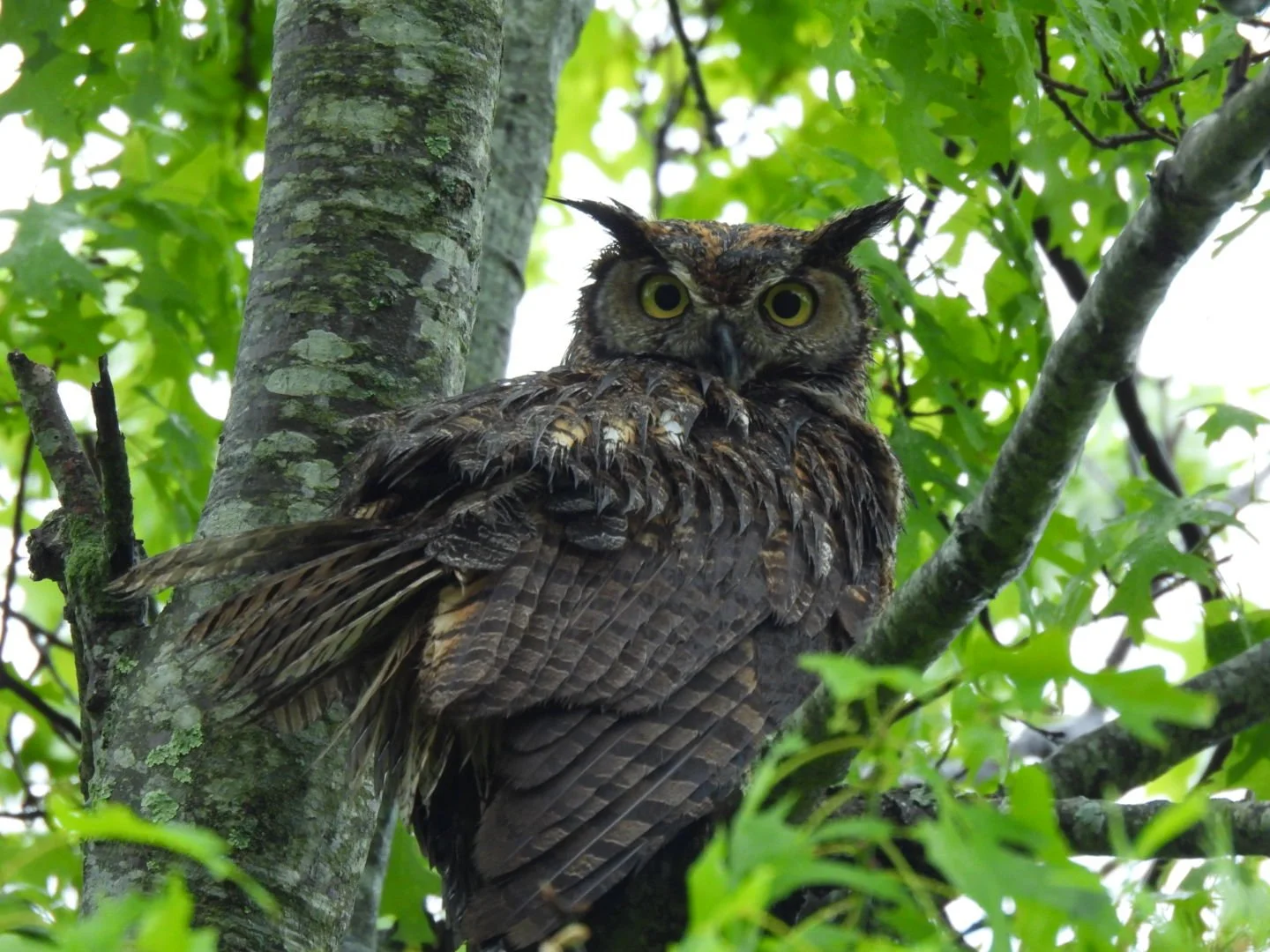
Great Horned Owl by J. Jensen
Theresa, Oscar and I begin trail maintenance at 6am every Saturday, but this Saturday I was there early, with a cup of coffee. The sun was just beginning to lighten the sky but it was still dusky. And silent. So quiet and peaceful. As I sat out back just taking it all in, I heard that mysterious, questioning, “whooo, whooo”. Then, after a minute or two, the answering “whoo, whooo” from afar. Yes! The Great Horned Owls were finishing up their nightly hunt and I was lucky enough to hear them communicating. Another morning we actually saw them, way up in a tree, looking like part of the tree, until they lifted off and spread their magnificent wings.
Adult owls can stand 18 to 25 inches with a wingspan or 40 to 60 inches. Five feet across!
The females are larger than the males, however the male has the larger voice box and deeper voice. The feather tufts on their head that look like horns are known as plumicorns, and help identify them, if you’re lucky enough to see them up close. The plumicorns serve as intimidation, camouflage, and a means to impress mates. They are wonderfully adaptable, living across North, Central and South America and can survive in forests, deserts, grasslands, wetlands and urban areas. They do not migrate, quite content to stay put in their territory. They have special soft feathers that break up the air turbulence and allow them to fly in complete silence. And they are mighty hunters, targeting rodents, rabbits, squirrels, raccoons and even crows, osprey and falcons. There is not much they won’t attempt to attack.
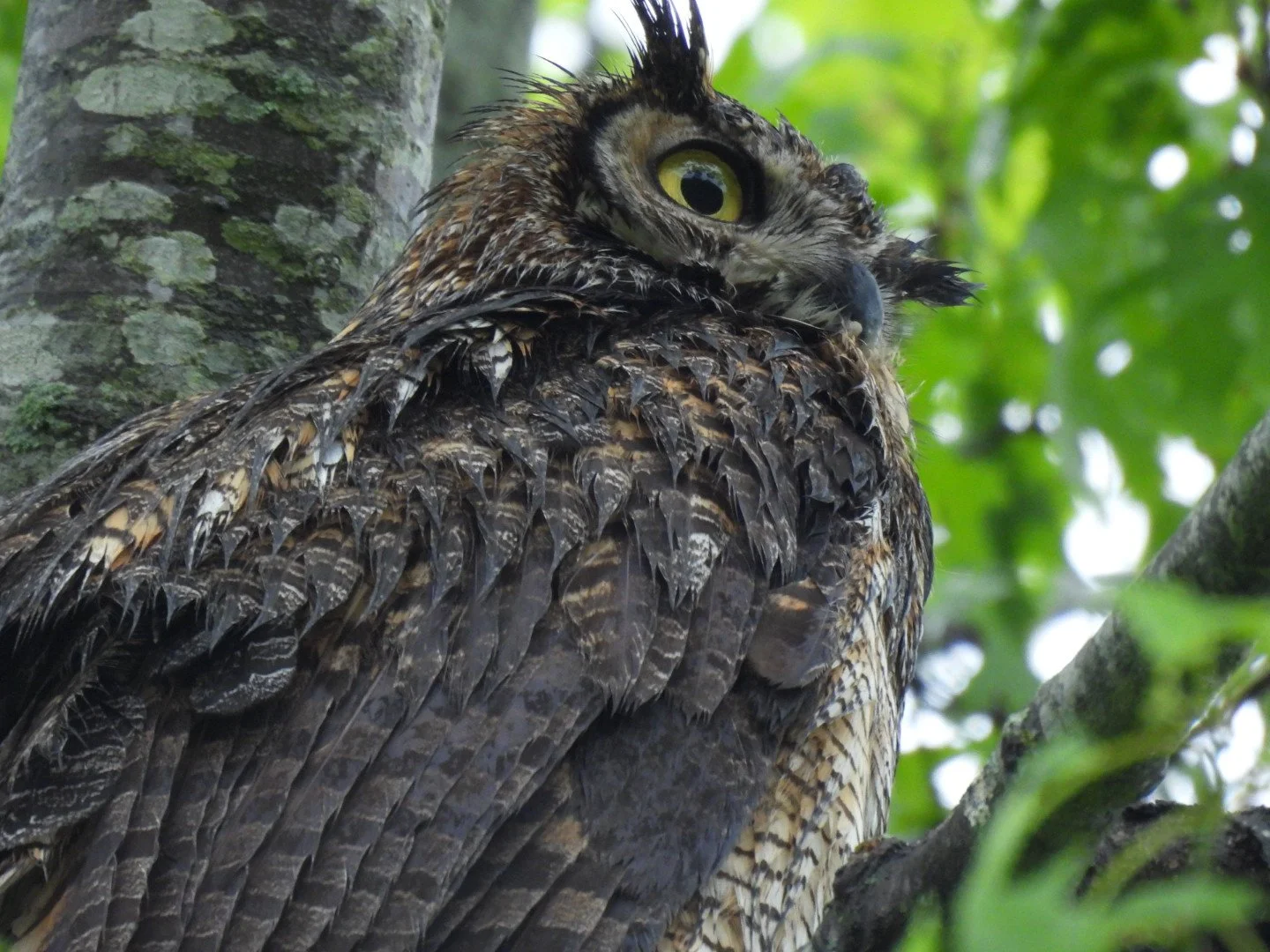
Great Horned Owl by J. Jensen
Their piercing yellow eyes are very large and deep and comprise 5% of their body weight, as opposed to our eyes which comprise only 0.003%. Our eyes would be the size of grapefruits if we were Great Horned Owls. They can even enlarge or reduce one pupil independently of the other, to handle mixed lighting, which helps them keep their hunting edge. Their heads turn up to 270 degrees, not quite a full 360, but very close. Also helping their hunting prowess are their ears which are not symmetrical. The right ear is higher than the left so they can pinpoint exactly where that small prey is, even in complete darkness. The Great Horned Owl is stronger than the eagle even though the eagle is much larger. They can lift prey that weigh more than they do, which I certainly can’t. And then there are their talons. Most raptors have three claws in front and one behind. Our owls are able to move two in front and two behind, giving them an edge in gripping prey and staying on their perch.
So many adaptations allow the Great Horned Owl to claim its moniker of Tiger of the Sky. It’s good to know we have some Great Horned Owls at Inlet Pond County Park. I might show up early more often to enjoy their presence.
Catch the Bird Song Sculpture Trail at Inlet Pond County Park Now Extended Until Dec. 1, 2026!
By Colleen McDonough
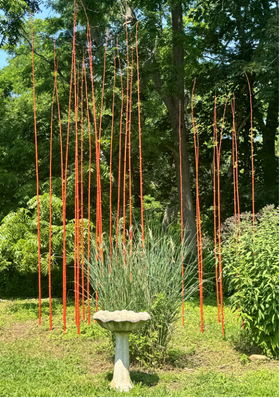
John Wittenberg, Invasive Beauty
If you haven't had a chance to walk the trails lately, there is still plenty of time to catch an incredible blend of local art and nature. The North Fork Audubon Society and the East End Arts Council have partnered to present Bird Song Project: A Sculpture Trail, made possible in part by a grant from the Suffolk County Department of Economic Development and Planning.
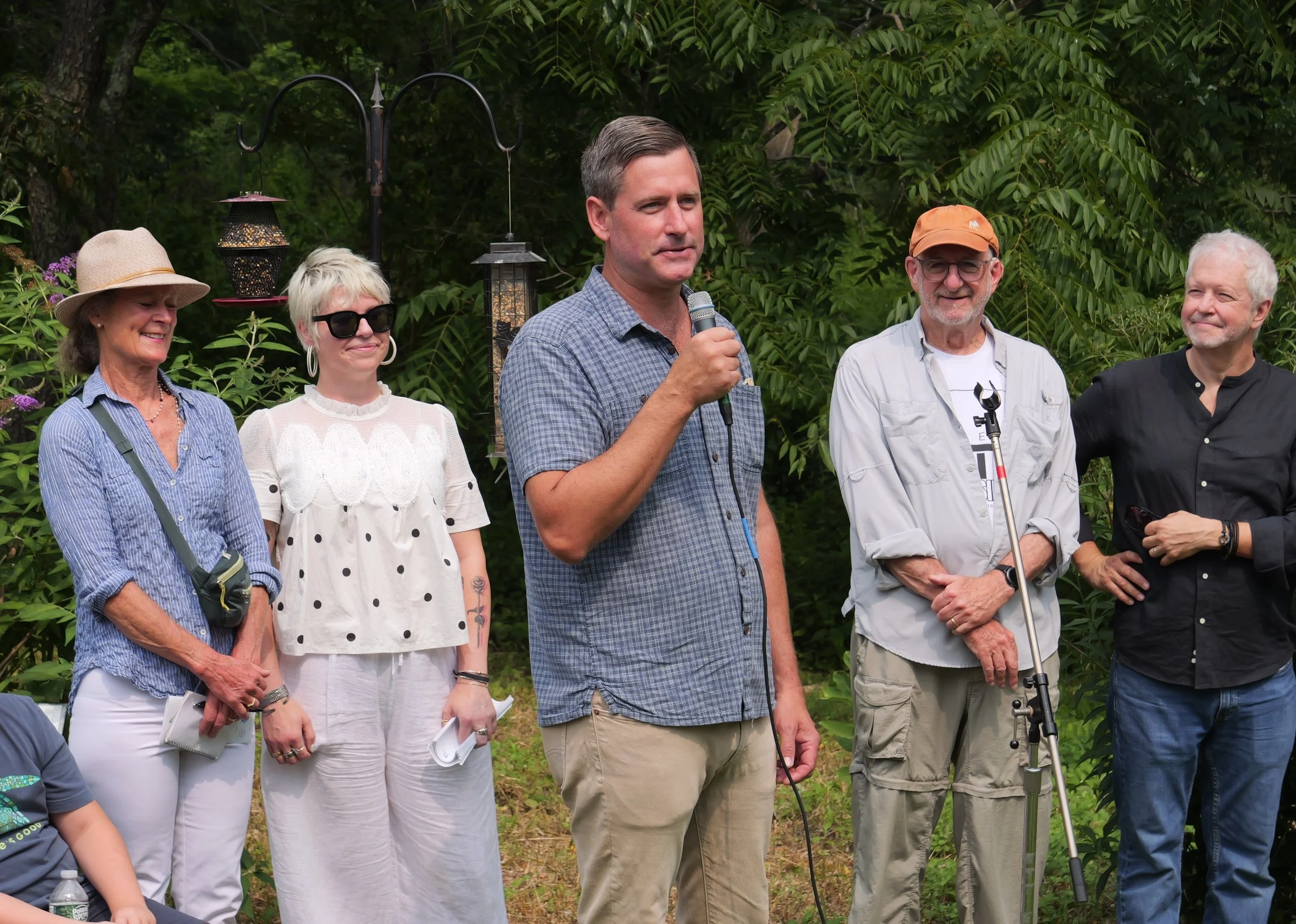
Legislator Greg Doroski speaking at the opening reception. From left: Peggy Lauber, NFAS President, Wendy Weiss East End Arts Council Executive Director, Legislator Greg Doroski, John Wittenberg & Jay Sylvester, sculpture artists.
While our summer artist reception has already passed, the outdoor exhibition remains fully open to the community.
The trail is open daily from dawn until dusk through December 1, 2026. Located at Inlet Pond County Park in Greenport, the exhibition features unique, original pieces by nine local artists, including Bill Albertini, Sherry Davis, Nathan Joseph, Scott McIntire, Arden Scott, Jay Sylvester, Ted Thirlby, John Warner, and John Wittenberg.
Why You Should Visit This Fall
Evolving Artwork: The sculptures, inspired by our local birds and wildlife, are crafted from fiber, stone, wood, bamboo, and metal to complement the park's natural features. As the late-summer foliage shifts into autumn, the changing landscape and seasonal foliage give walkers a brand-new perspective on each visit.
A Peaceful Stroll: The artwork is thoughtfully installed all along the scenic path that leads directly to the pond overlook.
Completely Free: This immersive outdoor experience is entirely free of charge for all visitors.
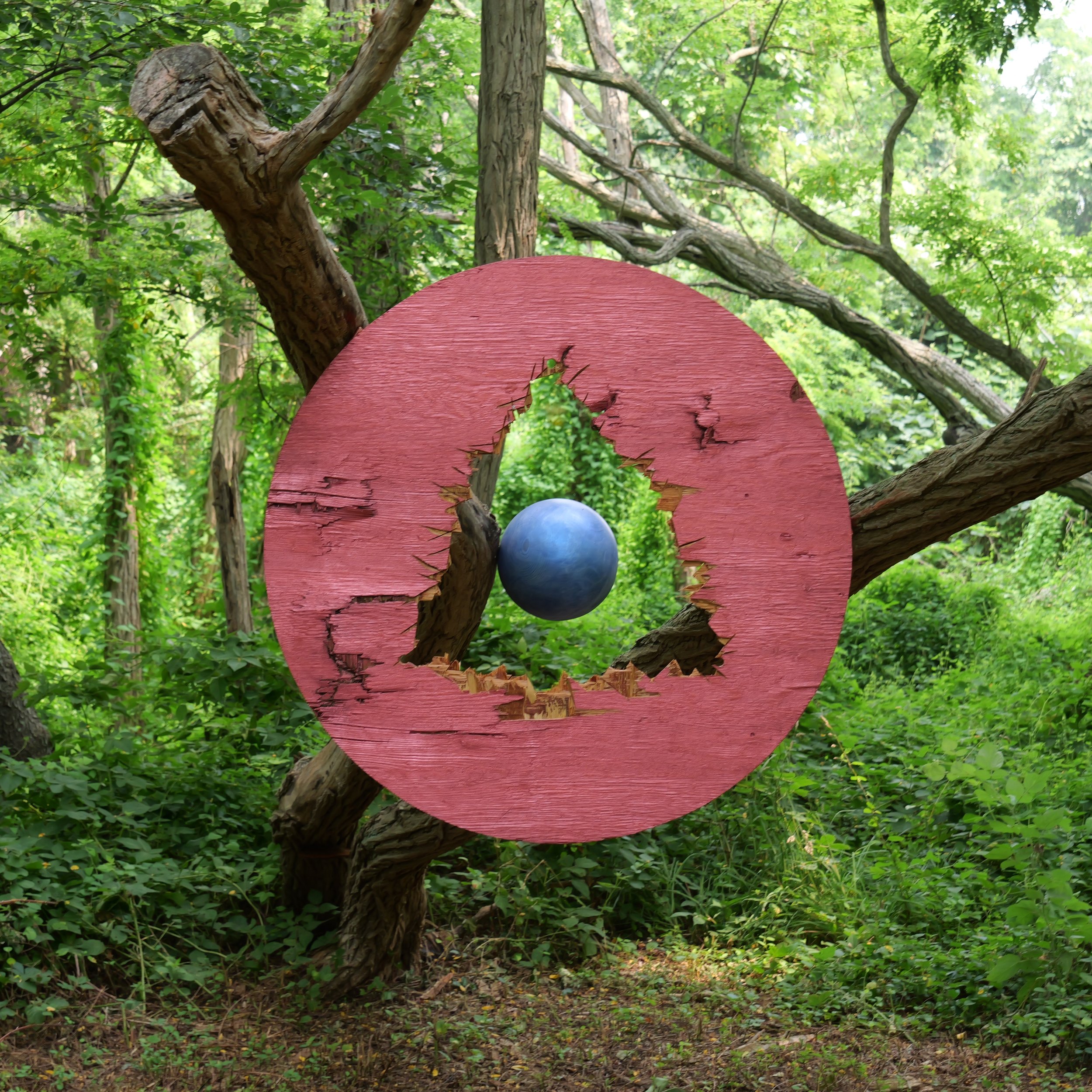
Keyhole by Ted Thirlby (Photo taken by Mike Tillman)
Don't miss out on this unique opportunity to connect with local art and the beautiful biodiversity of the North Fork!
To learn more about the project and view the Sculpture Tail map, visit the North Fork Audubon Society website, or better yet, head over to North Fork Audubon and take that walk in the park. Sculpture Trail maps are located onsite.
Hibiscus moscheutos Thriving at Inlet Pond County Park
By Theresa Dilworth
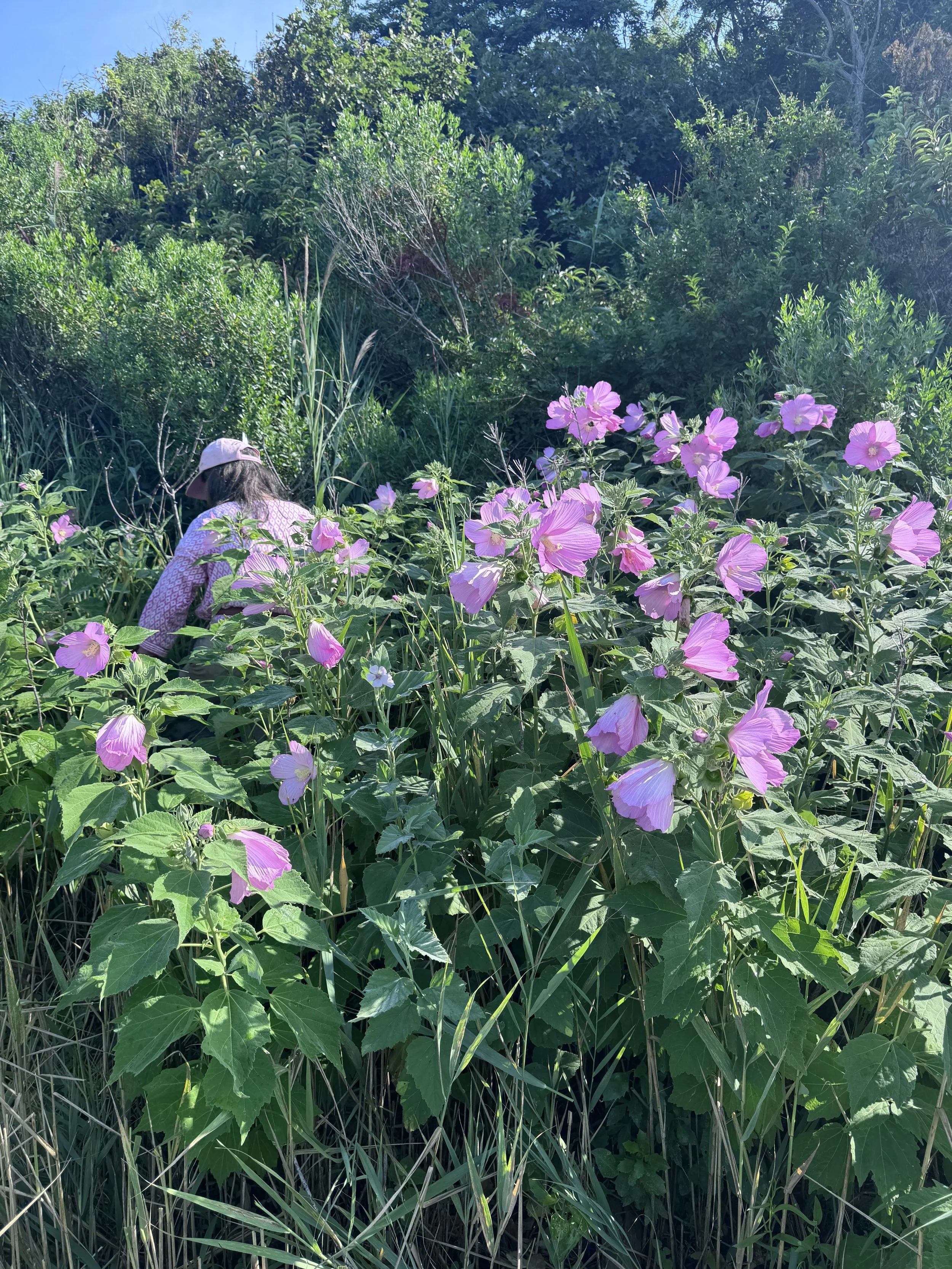
Hibiscus moscheutos at Inlet Pond County Park, (Area 10 on the map)
Hibiscus moscheutos, commonly called hardy hibiscus, rose mallow, or swamp rose mallow, is a fascinating native North American plant in, the mallow family (Malvaceae), along with cotton, okra, cacao, and hollyhocks.
The flowers can be enormous, making them among the largest flowers of any hardy perennial grown in temperate climates. Unlike the tropical hibiscus commonly sold as patio plants, H. moscheutos is native to the eastern and southeastern United States. It loves wet feet, and its natural habitat includes swamps, marshes, wet meadows, and stream edges.
It is a pollinator magnet. Bees, butterflies, and hummingbirds are attracted to the large, conspicuous flowers which provide abundant pollen. Bees often visibly collect it from the prominent central column. The flowers are short-lived – an individual blossom generally lasts only one day - but a mature plant can produce so many buds that it may look continually covered in flowers for weeks.
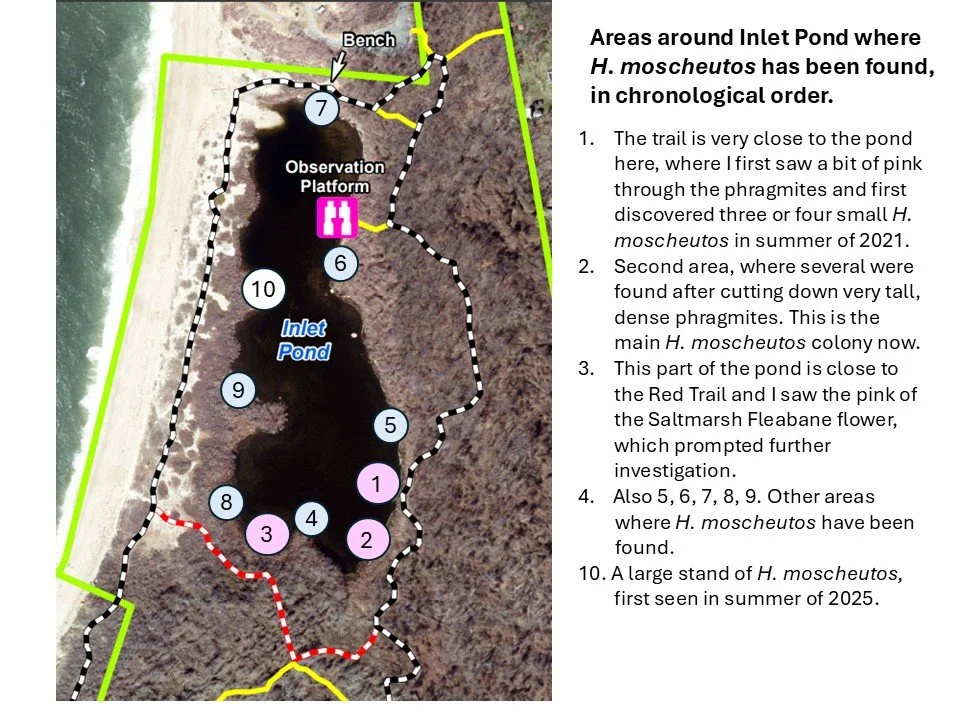
I saw my first swamp mallows at Inlet Pond along the edges of the east side of the pond in summer of 2021. At that time, invasive phragmites (Phragmites australis) about 8-10 feet tall created a thick, deep wall along the pond edges, and it was impossible to see the pond. The phragmites not only dominated the area from pond edge to trail, but were starting to grow on the landward side of the trail. I notice a few flashes of bright pink through the dense vegetation. That’s when I decided enough was enough and started to cut back the phragmites, and uncovered three or four very small, scraggly, H. moscheutos, about 24 inches high, along the banks of the pond, barely surviving through the phragmites.
After the first tiny area of three or four plants, I noticed a second, larger area on the southeast of the pond where a few weak H. moscheutos managed to survive through the dense phragmites. The third area I found was off the Red Trail, where again, a flash of pink caught my eye through the vegetation. This time it was the Saltmarsh Fleabane with a lavender-pink flower but upon further investigation I also noticed H. moscheutos.
My research indicated that the best time to cut phragmites is late August or early September, when they are at their peak height and strength, and are flowering. That is the time of year when they start to translocate nutrients from their tall stems down to their rhizomes for storage through the winter dormancy period. Cutting them prevents the translocation and weakens them for the next year, and also prevents seed spread.
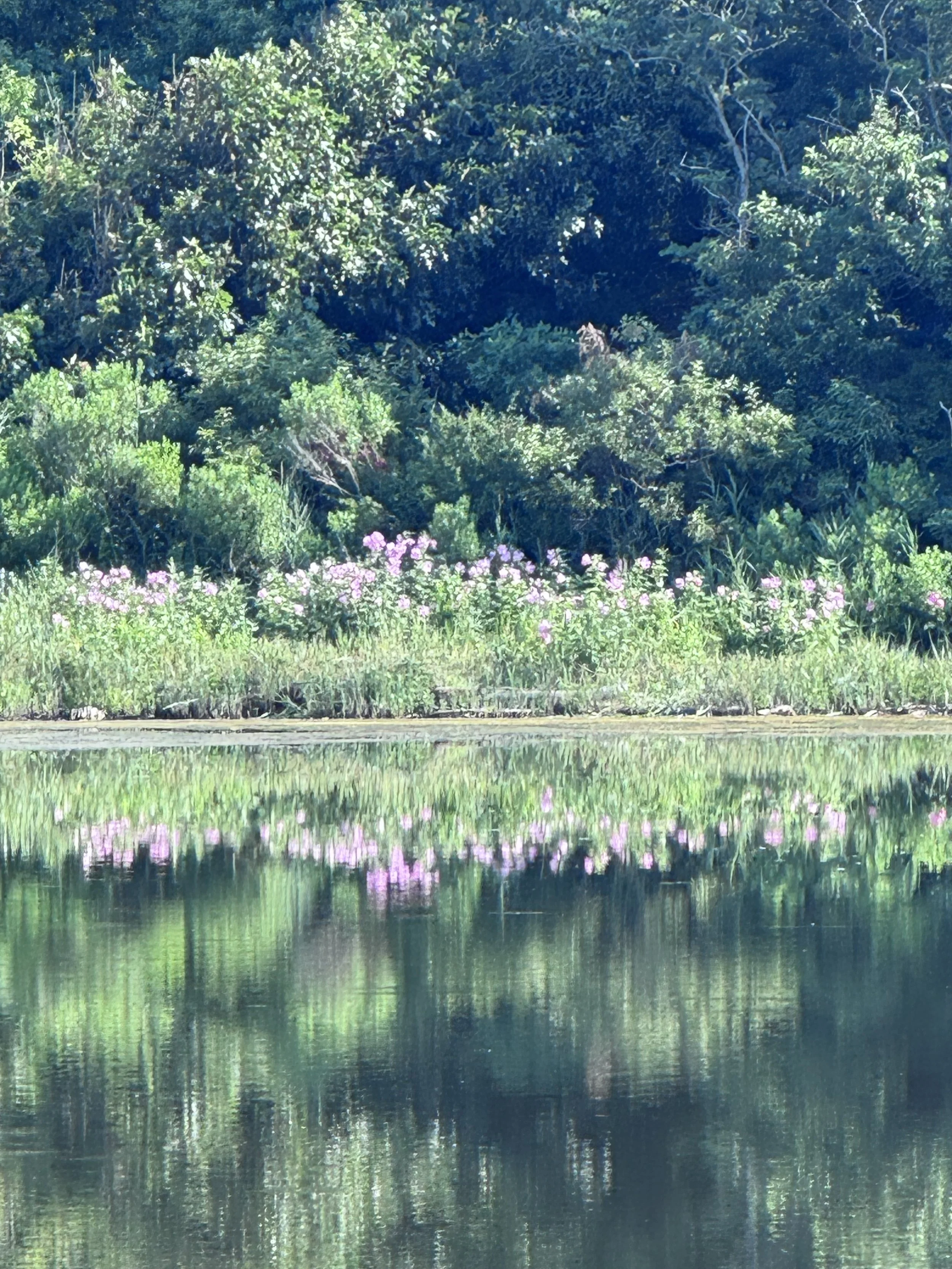
Hibiscus moscheutos at Inlet Pond County Park, (Area 7 on the map)
Through Suffolk County Parks Department we obtained a five-year Department of Environmental (DEC) permit to continue cutting down the phragmites. For the next few years, Carol, Oscar and I have kept trimming the phragmites at those initial two areas, plus others. We simply cut them down to about two or three feet of height to let other plants get sunlight and compete. According to NFAS Board member and Weed Science Specialist, Andy Senesac, PhD, H. moscheutos can outcompete phragmites.
Because they are salt-tolerant, MaryLaura Lamont of Hallock State Park has planted them near the road on Sound Avenue – they can tolerate road salt. Inlet Pond is brackish and has been measured at 14% salinity (about halfway between pure freshwater and pure saltwater).
The H. moscheutos prolifically produce seed pods. Each year we see more and more “babies” growing at the feet of the adult plants. It is my hypothesis that the occasional flooding of the original areas carried seeds to the opposite shore of Inlet Pond, the side closer to the beach, and to the north side, because in the summer of 2025 we started to see patches of H. moscheutos in a few areas where we never saw them before. We now have H. moscheutos growing in about ten distinct areas around the pond, including a large stand directly across from the viewing platform.
Moore's Woods: A Living Laboratory
By Peggy Lauber
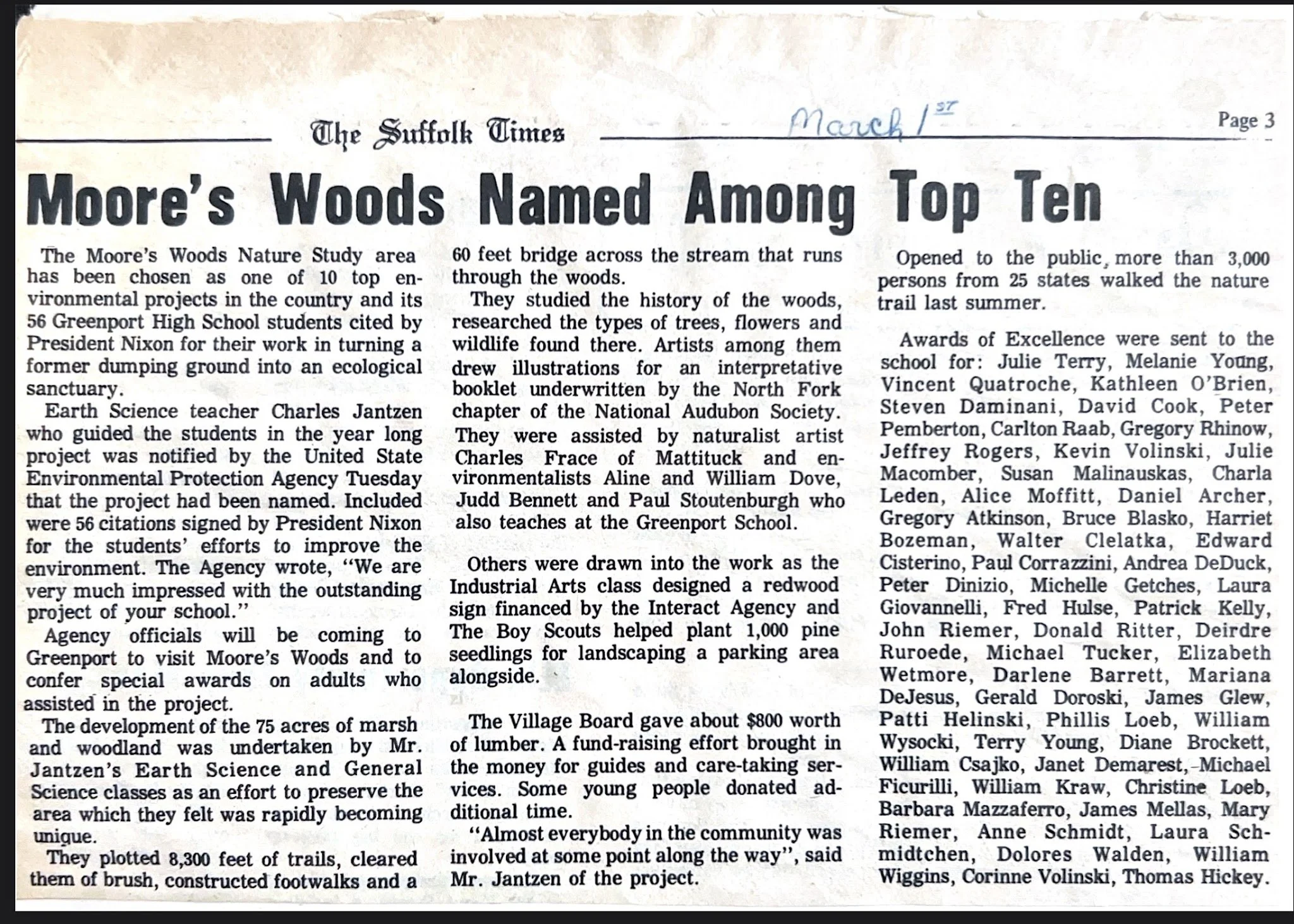
The Suffolk Times article from 1971
Moore’s Woods in Greenport, home of rare plants, vernal wetlands and old growth trees that populate this forest and support a wide variety of birds, insects and amphibians, is the only one of its kind on Long Island. It was deeded to the Moore family in 1640 by King James. It is famous for its orchid flora, including the cranefly orchid which is found nowhere else in New York State. To quote North Fork naturalist Paul Stoutenburgh: “these woods were the living laboratory of Roy Latham, that famous naturalist of Orient.”
A lot has happened to the forest since 1640. Around 1870, ditches and culverts were dug so that Silver Lake would drain west and then south into Peconic Bay — thus the name Moore’s Drain. Soon the project was called Moore’s Folly, when it was learned that Silver Lake is a spring-fed lake (!).
Coincidentally in 1971, the same year that North Fork Audubon Society was founded, a group of students at Greenport High School, under the tutelage of teacher Charles Jantzen and naturalist Paul Stoutenburgh, launched an ambitious project in Moore’s Woods. The students created an interpretive nature trail network there that was so successful, they had over 4,000 visitors and employed 3 high school students to work as guides that summer – and they won a Presidential Commendation award for their efforts. I only recently learned that North Fork Audubon donated the funds and expertise in 1971 to create an extensively researched and illustrated trail guide to accompany the project, entitled Greenport Nature Study Area. On the first page it states “…this guide to Moore’s Woods is dedicated to the Greenport Village Board for their foresight and wisdom in keeping this unique area in its natural state as a living sanctuary for this generation and those to come.”
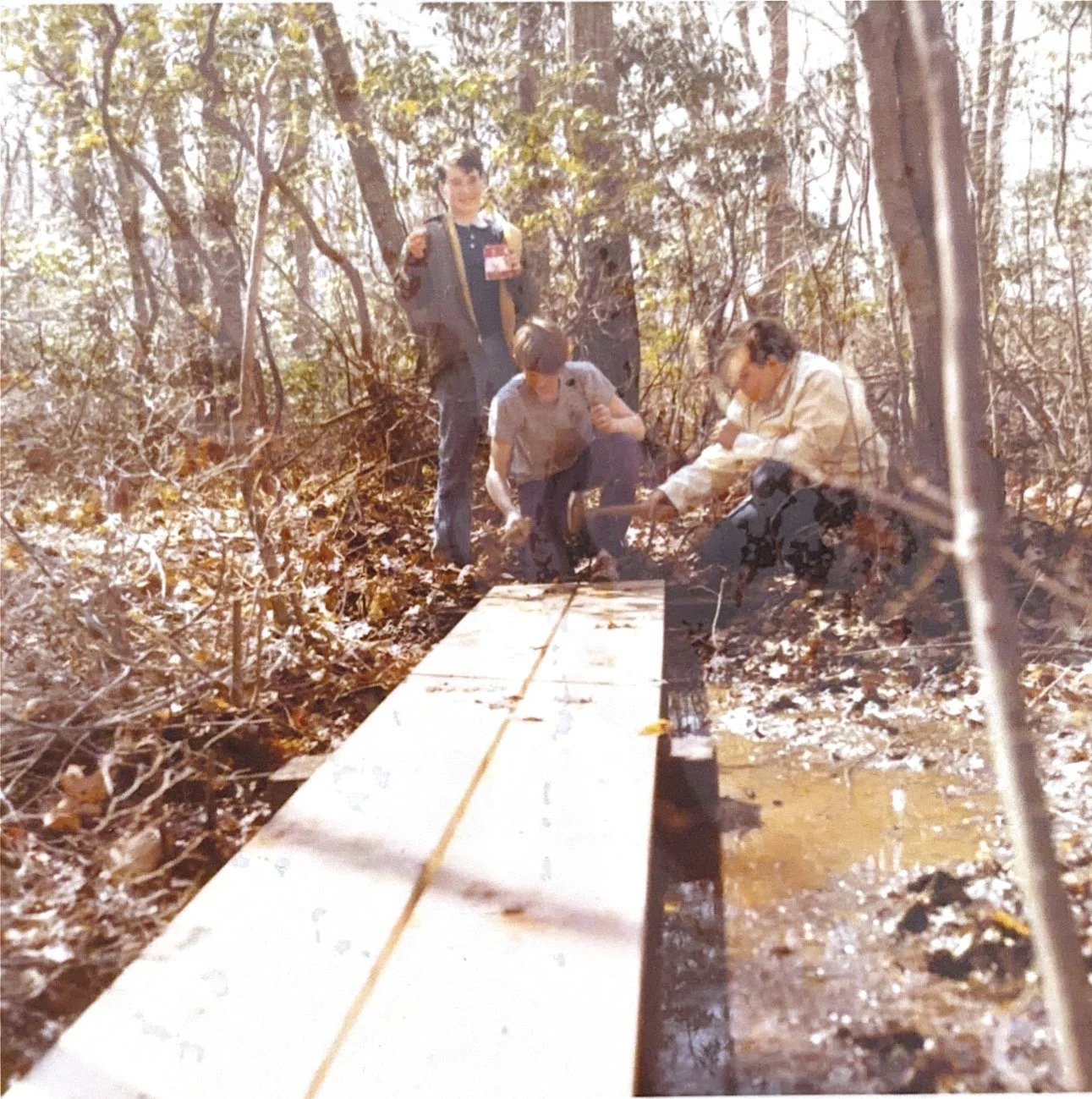
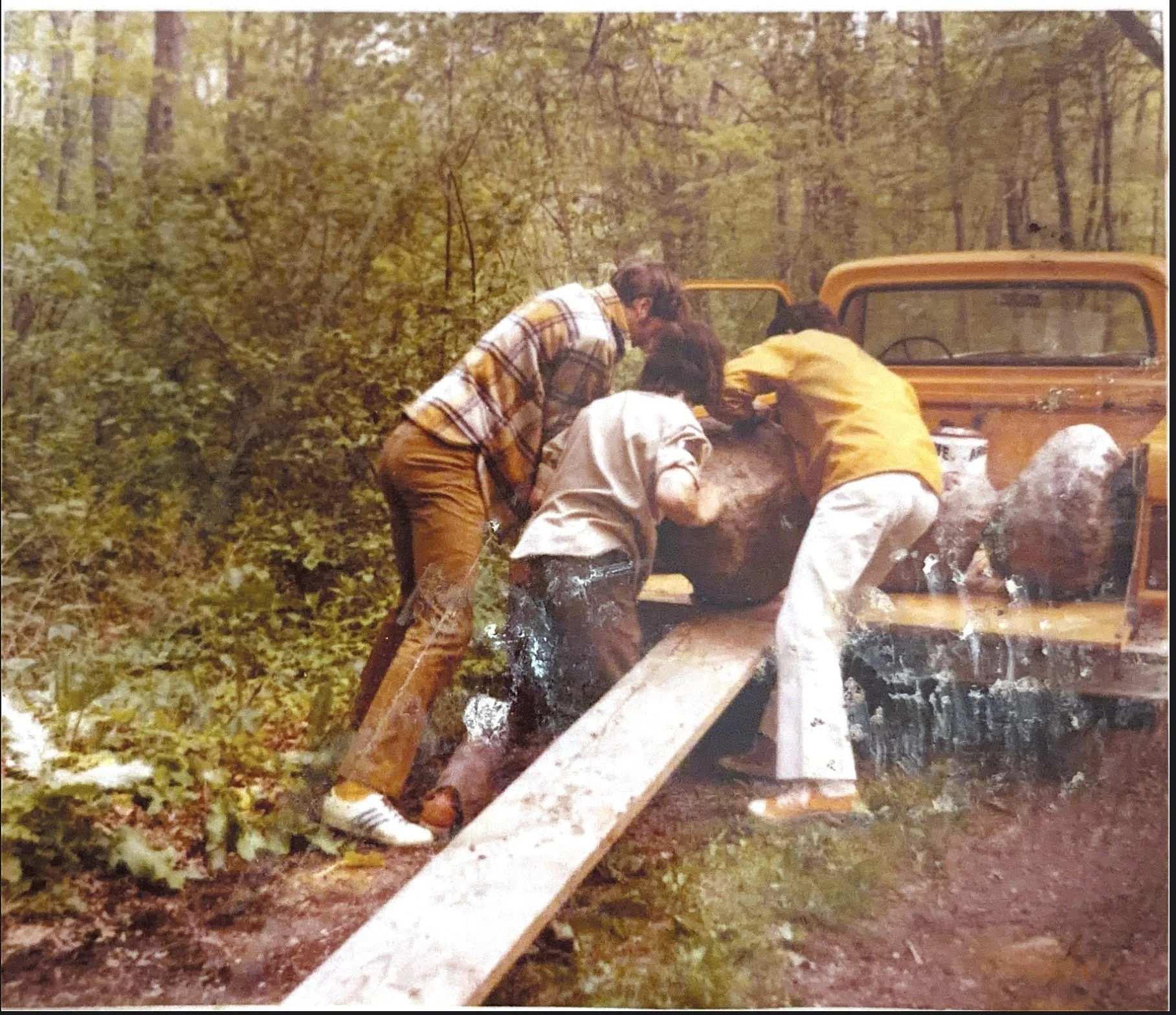
Greenport High School Students working in Moore’s Woods in 1971
Beginning more than 30 years ago, longtime Greenport resident and naturalist George Rowsom maintained a bird-banding station in Moore’s Woods under the auspices of North Fork Audubon Society. At the time, the trail that had been cut by the GHS students still functioned and connected the bird-banding station to North Fork Audubon’s headquarters — the path emerged on the North Road, just kitty-corner to the entrance of the Red House, as it was called at the time. I remember the years that George put up his mist nets and welcomed the opportunity to show visitors how he examined the birds caught in the nets (and safely released of course), carefully logging in statistics about their age, weight, origin and so on, which were then tabulated by the US Geological Survey National Bird Banding Laboratory. Eventually however, his banding station was repeatedly vandalized, so he relocated it to Dam Pond (Ruth Oliva Preserve) in East Marion.
Over time, little by little pieces of the woods have been carved out: A Village dumping area to the north of the skate park behind the water tower. The water treatment plant at Malarky Lodge. A power substation on the northernmost edge of the woods and one on the southernmost edge. A mini-train cut into the western edge of the woods behind the Moore’s Lane skate park. While the woods continue to be used by a handful of community members who enjoy nature hikes, dog walkers, birders and botanists, the bulk of the 200-acre woods seems to have been forgotten by its owners, Greenport Village, except as a dumping ground for garbage or perhaps an opportunity to ride ATVs off the trails — which are now overgrown and mostly impassable — or a place to hunt off-season for deer.
And now in 2026 we have two Greenport High School students who have stepped forward in the hope of reclaiming some of the previous glory of Moore’s Woods. Much to my surprise and delight, Greenport High School student Noelle Stevenson submitted an AP research paper this spring entitled Investigating a Decline in Community Engagement and Upkeep of Moore’s Woods on the North Fork of Long Island. As Ms. Stevenson observed, “Today, despite (Greenport’s) tremendous accomplishment in the 1970s, Moore’s Woods exists quietly in a state of disrepair.” She hypothesized that “a decline in community efforts to upkeep and use the woods has negatively impacted the state of Moore’s Woods as well as its community.” After conducting a survey of community residents, her conclusion was that there is great potential for future research regarding Moore’s Woods, including perhaps studying the health of the woods and an investigation of its biodiversity: “Moore’s Woods can be considered a virtually unused resource in the present day.”
Ms. Stevenson requested and received permission from the Village of Greenport to build a new kiosk at the entrance to the original trail (located on Moore’s Lane). By constructing the kiosk, she hopes to draw attention to the trails and perhaps jump-start a community effort to rebuild them.
Also this spring, to honor his grandfather George Rowsom, Alexander Rowsom decided to focus his efforts to attain Eagle Scout status on a project in the same area where his grandfather’s bird-banding station was located. Mr. Rowsom has received permission from the Village of Greenport, as well as from his Eagle Scout advisor to construct new benches along that section of the trail – or what remains of it, as it exists now in disrepair.
At North Fork Audubon we applaud the efforts of these young people to take the lead in injecting new life and a positive approach to the restoration of Moore’s Woods. We hope to spearhead a project to update the Greenport Nature Study Area guide in 2027. This would first require extensive research to determine what flora and fauna have changed in status or disappeared since the guide was originally produced 55 years ago. NFAS member and wildlife biologist Mary Bertschi has suggested hosting a series of BioBlitzes, which would need to be undertaken seasonally in the woods over the course of a year. If any readers of this article would be interested in participating in this or any effort to restore Moore’s Woods, please contact us @ info@northforkaudubon.org
It takes a Village!
Birds without Borders Exhibit
Opens December 12th at Floyd Memorial Library
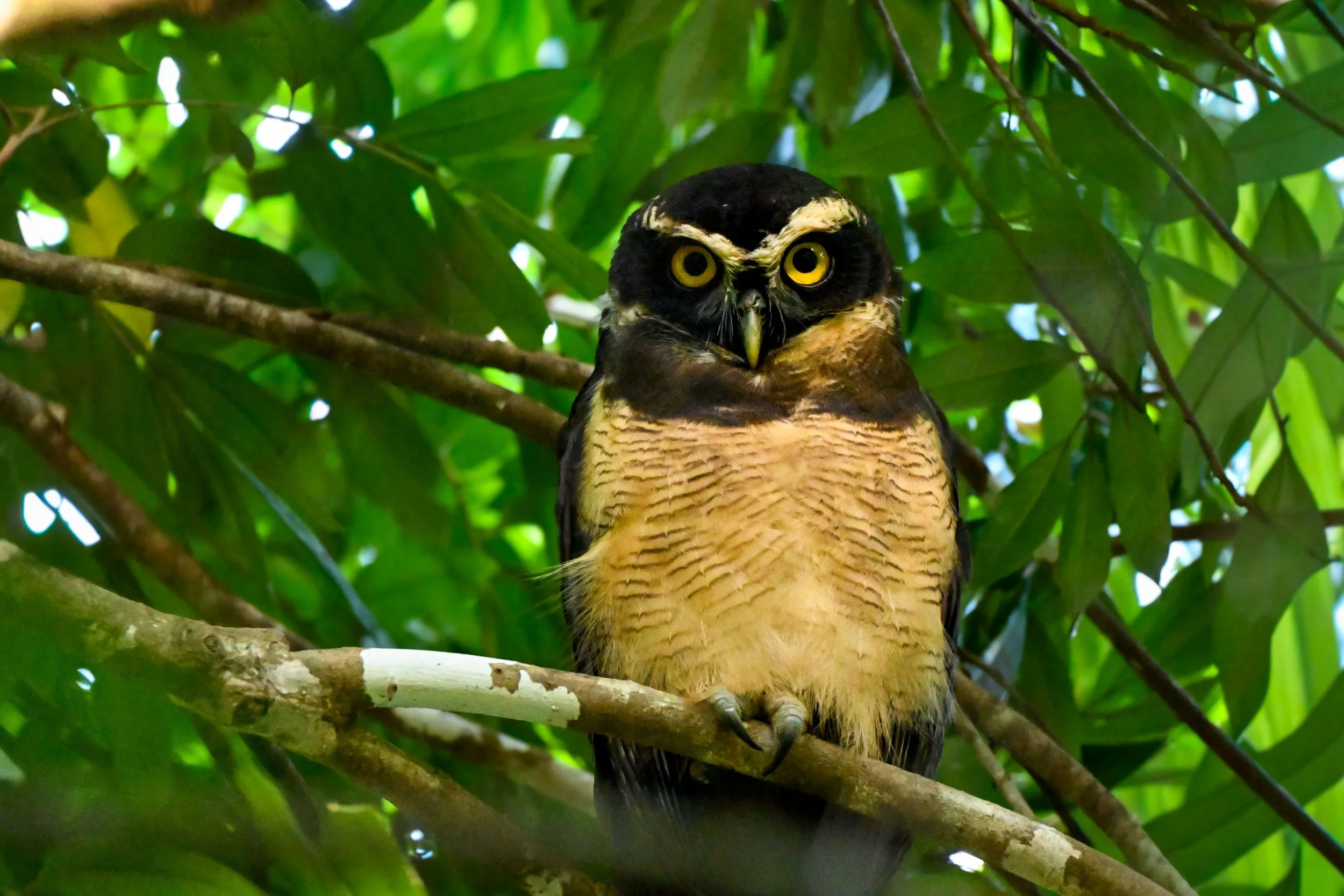
Spectacled Owl by Mary Bertschi
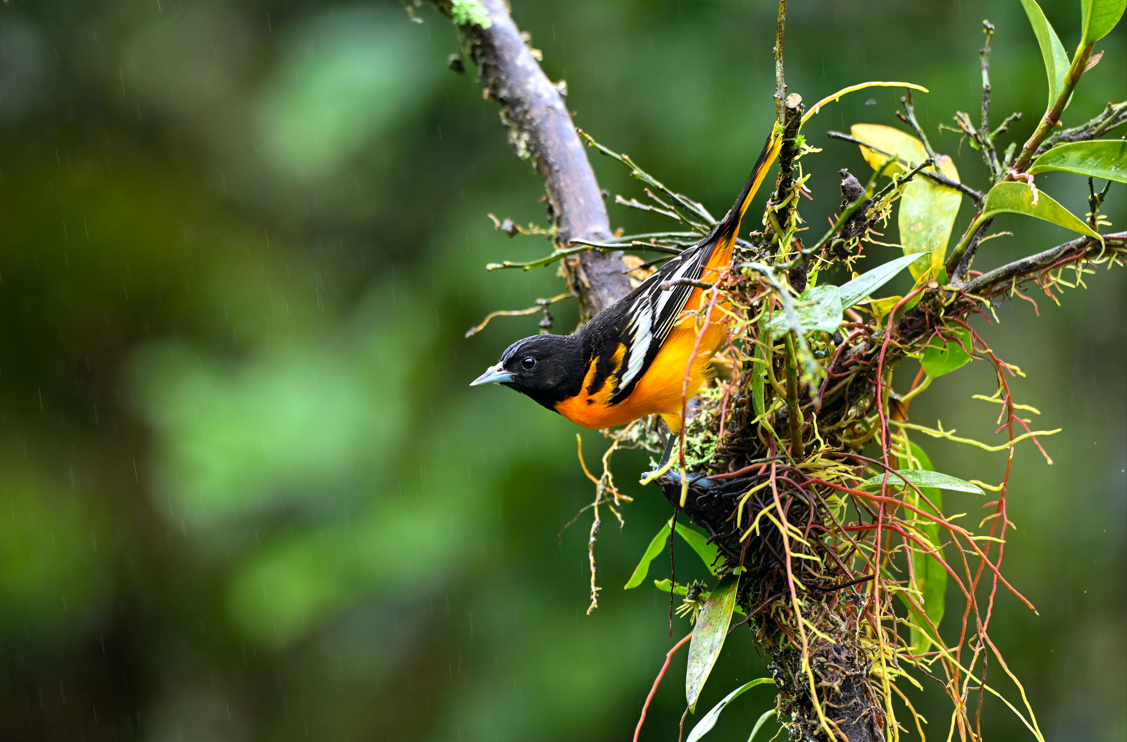
Floyd Memorial Library in Greenport is pleased to present “Birds Without Borders,” an exhibit showcasing North Fork Audubon’s partnership with Aves Honduras, an organization committed to the protection of bird habitats in Honduras. At the December 12th, 2 PM opening of the exhibit, wildlife biologist and nature photographer Mary Bertschi will talk about the beautiful photos she took during her recent trip with North Fork Audubon members to visit wildlife sanctuaries there. This Central American country hosts more that 800 species of birds, including our beloved Baltimore Oriole, which breeds on the North Fork during the spring and summer months and then migrates to Honduras during the winter months. Mary and North Fork Audubon president Peggy Lauber will discuss their experiences in Honduras and why their work with Aves Honduras is so important to birds that live on the North Fork.
A major initiative of North Fork Audubon is to support a hemispheric approach to the protection of birds by helping people and organizations with scarce resources. North Fork Audubon chose to work with Aves Honduras and learn about and support the sanctuaries they are creating and strengthening. These sanctuaries, often farmed by indigenous people, provide an additional source of income to encourage land protection and help prevent deforestation. Aves Honduras and its sanctuaries also educate and spread awareness of birds to local communities.
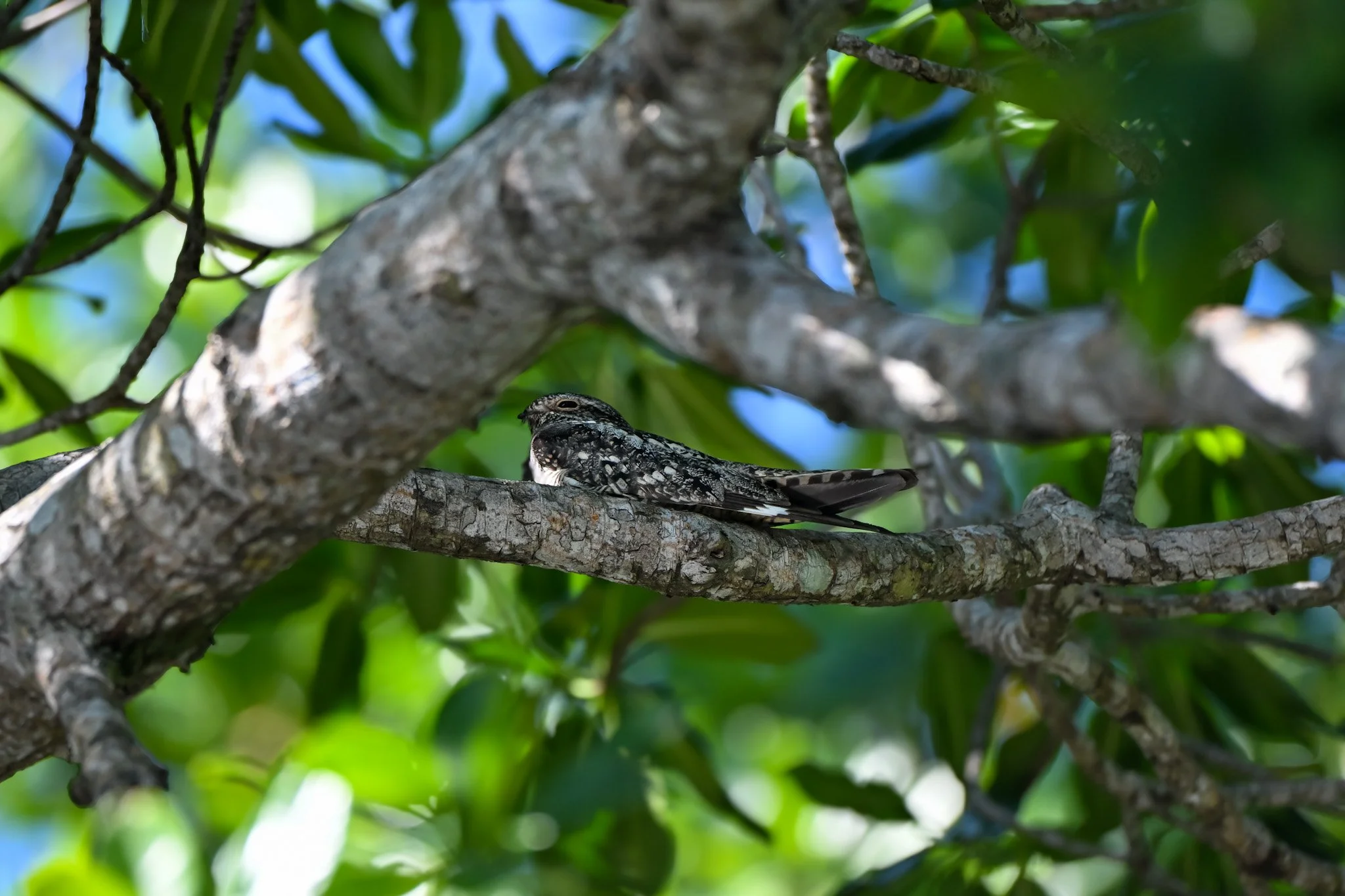
Lesser Nighthawk by Mary Bertschi
The exhibit will also showcase North Fork Audubon’s work on Long Island, including photos that Mary has taken of our resident and migrating local birds, such as the American Oystercatcher and Piping Plover.
Come to the exhibit to learn and celebrate North Fork Audubon’s exciting initiatives. Click here to learn more about our sistership initiative with Aves Honduras.
We hope you enjoyed this issue of The Kingfisher. As we welcome the slower pace of fall and winter, the work of North Fork Audubon Society continues. We have a wide array of programs, initiatives and events planned for this year and beyond.
Check out a few of our upcoming offerings below, sign up our mailing list and follow us on Facebook and Instagram to stay connected. Consider becoming a member or making a donation to support our work and help us continue our mission to Connect People with Nature.
Here are some featured programs and events happening soon!
Monthly Bird Walks including Beginner Birder, Friday Morning Birders, Tuesdays with Tom and Sunday Morning Birding
Bird Song Project: Sculpture Trail available until December 1, at Inlet Pond County Park
Volunteer Appreciation Party - December 6th at the Red House - *more details to come*
Photo Exhibit: Birds without Borders at Floyd Memorial Library in Greenport, opening on December 12th
Aves Honduras Bird Sanctuary Tour - we are partnering with Aves Honduras to offer two special birding experiences for 2027