A Publication of North Fork Audubon Society, Inc
Spring is finally here, bringing new life, new partnerships, and new opportunities to connect people with nature! In this issue we’re excited to share our growing sistership partnership with Aves Honduras, celebrate the completion of our Berries for Birds Garden, and explore important topics like weed management and the conservation of diamondback terrapins. Thank you for being part of our community as we continue to work together to protect and appreciate the wildlife and habitats of the North Fork. Be sure to read through to the end to see our upcoming programs and events you won’t want to miss!
Sistership Project with Aves Honduras
by Peggy Lauber & Mary Bertschi
Birds know no borders, but they do know how to survive. With an intelligence beyond human capacity, many locally familiar birds—for example, the Baltimore oriole, wood thrush and chestnut-sided warbler, which visit the North Fork during their northward spring migration or stop and breed here during spring and summer—make a perilous journey every year back to Central and South America to overwinter there.
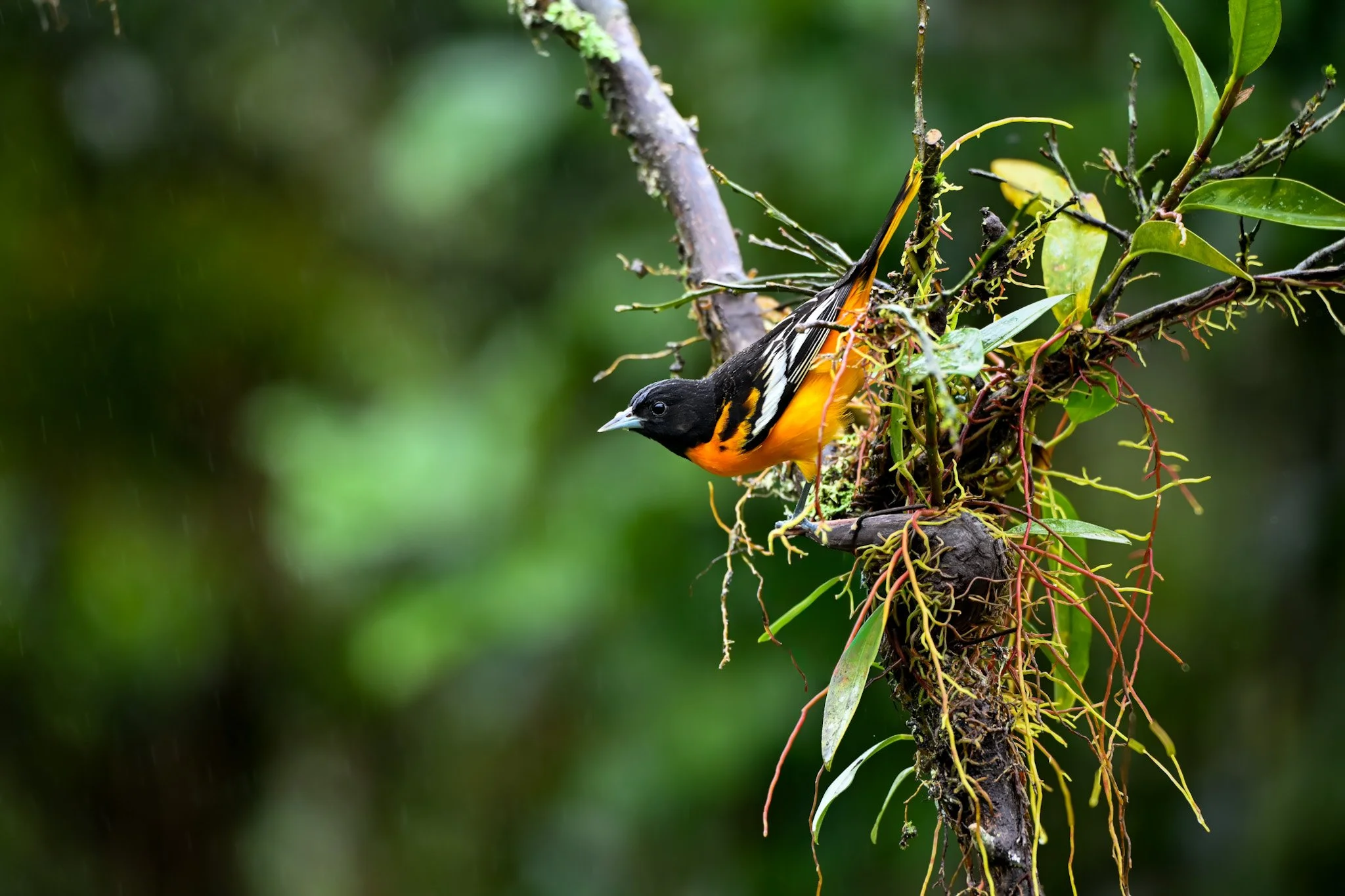
Baltimore Oriole by Mary Bertschi
A recent ornithological study revealed a disturbing fact: these migrating birds are suffering severe declines in their populations due to rapid deforestation in Latin America, much of it at the hands of drug cartels. Inspired by a bequest from longtime North Fork Audubon Society board member and supporter Rick Kedenburg, NFAS formed a committee to explore how we can help these birds in the places where they spend eight months each year beyond the North Fork.
Fast-forward to our recently signed “Sistership Agreement” with Aves Honduras, a group committed to creating and protecting land preserves in critical bird habitat areas. By encouraging active private ownership by indigenous people and promoting eco-tourism, we can help protect these lands from deforestation by nurturing an appreciation for these birds in both their breeding and winter homes.
To see for ourselves if this were a worthy endeavor, twelve of us—including our scholarship wildlife biologist and nature photographer, Mary Bertschi—recently visited Honduras to assess these existing and proposed sanctuaries. In this issue of The Kingfisher, we are delighted to share Mary’s insights as well as her photos of the spectacular birds we saw there.
-Peggy Lauber, North Fork Audubon Society President
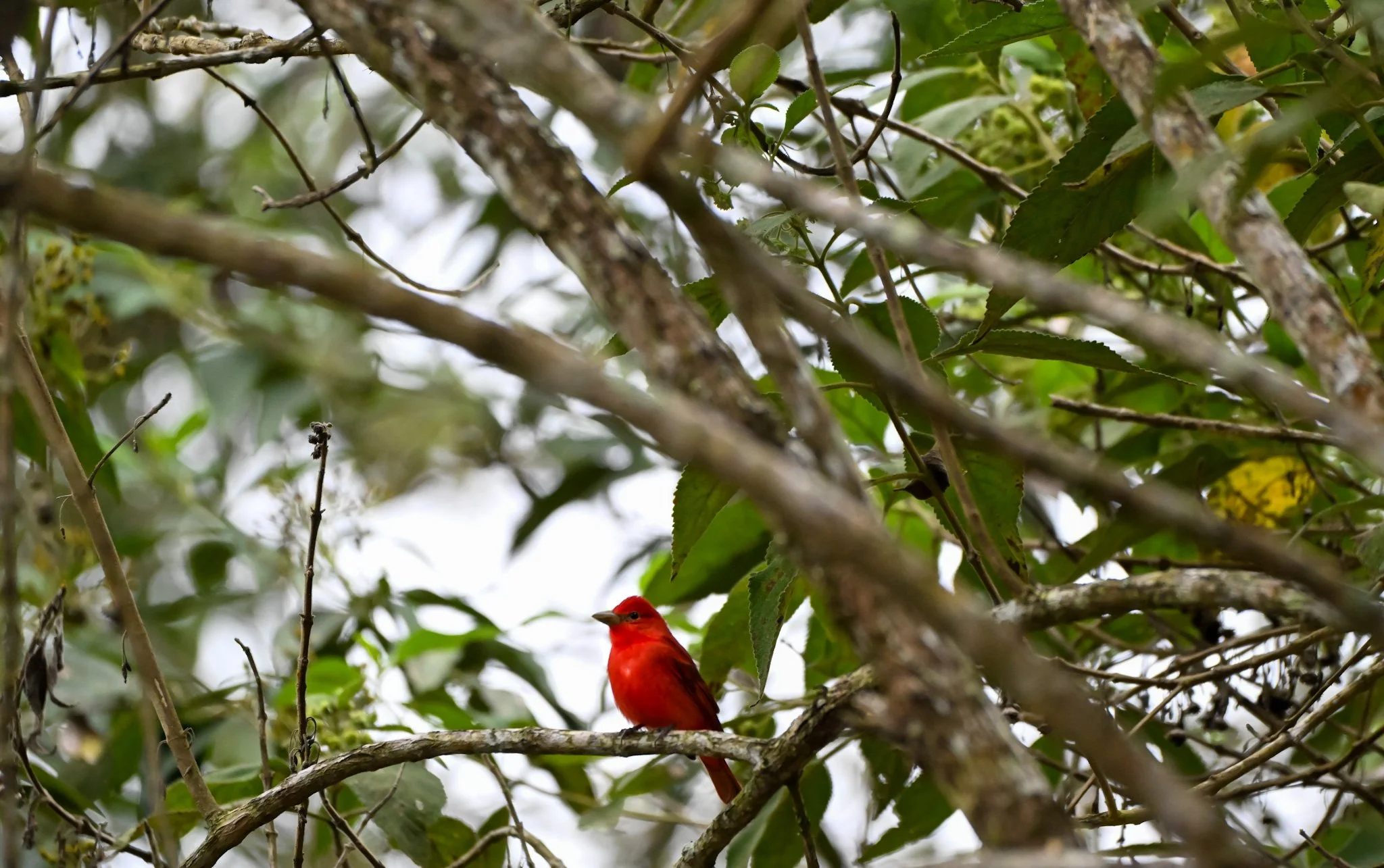
Summer Tanagers by Mary Bertschi
Honduras is the most mountainous country in Central America, with approximately 75% of its territory covered by mountains, shaping biodiversity patterns as well as accessibility challenges across the network of sanctuaries. The country also sits at a remarkable biogeographic crossroads, marking the northernmost range limit for many South American species and the southernmost limit for many North American ones, which helps explain why a relatively small country can support such extraordinary avian diversity of over 800 species.
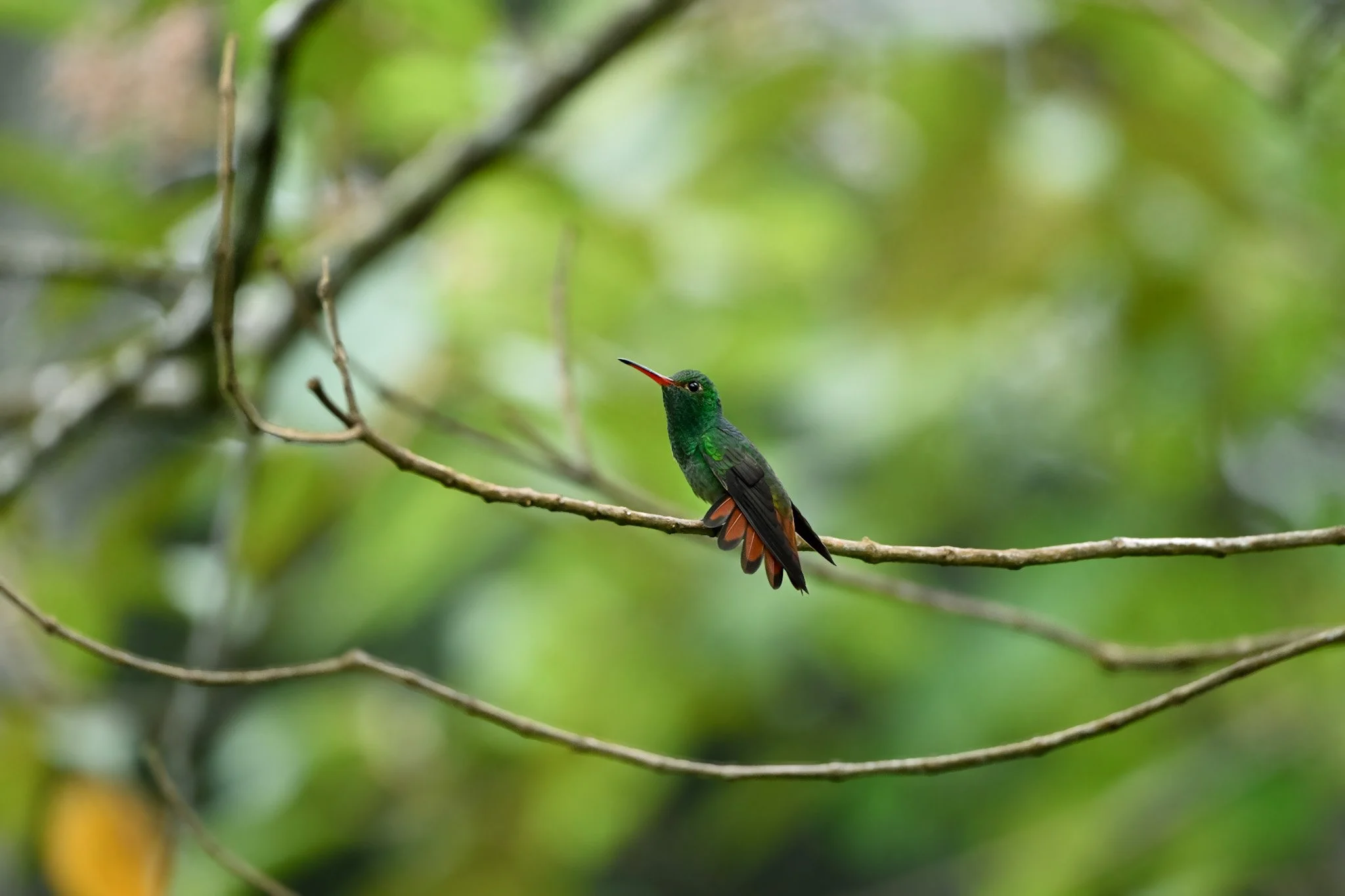
Rufous Tailed Hummingbird by Mary Bertschi
In almost every sanctuary we visited, we saw neotropic migrants, birds like the Baltimore oriole that are a backyard staple on the North Fork in the summer. These long distance migrants, like Orchard Orioles, Summer Tanagers, Wood Thrushes, and Hummingbirds, among dozens of others, rely on health ecosystems across continents to survive. We witnessed first-hand the other half of their lives, foraging for insects among coffee plants or flitting high in the treetops in the rainforests. We also saw a cornucopia of other remarkable birds unique to Central and South America, such as the Lovely Cotinga, Bare-Throated Tiger Heron, and Orange-billed Nightingale Thrush. The incredibly rich biodiversity at each site showcased the care and intention Aves Honduras was exercising when adding new sanctuaries to the project, as each site seemed to be critical wintering habitat for many of these long distance migrants.
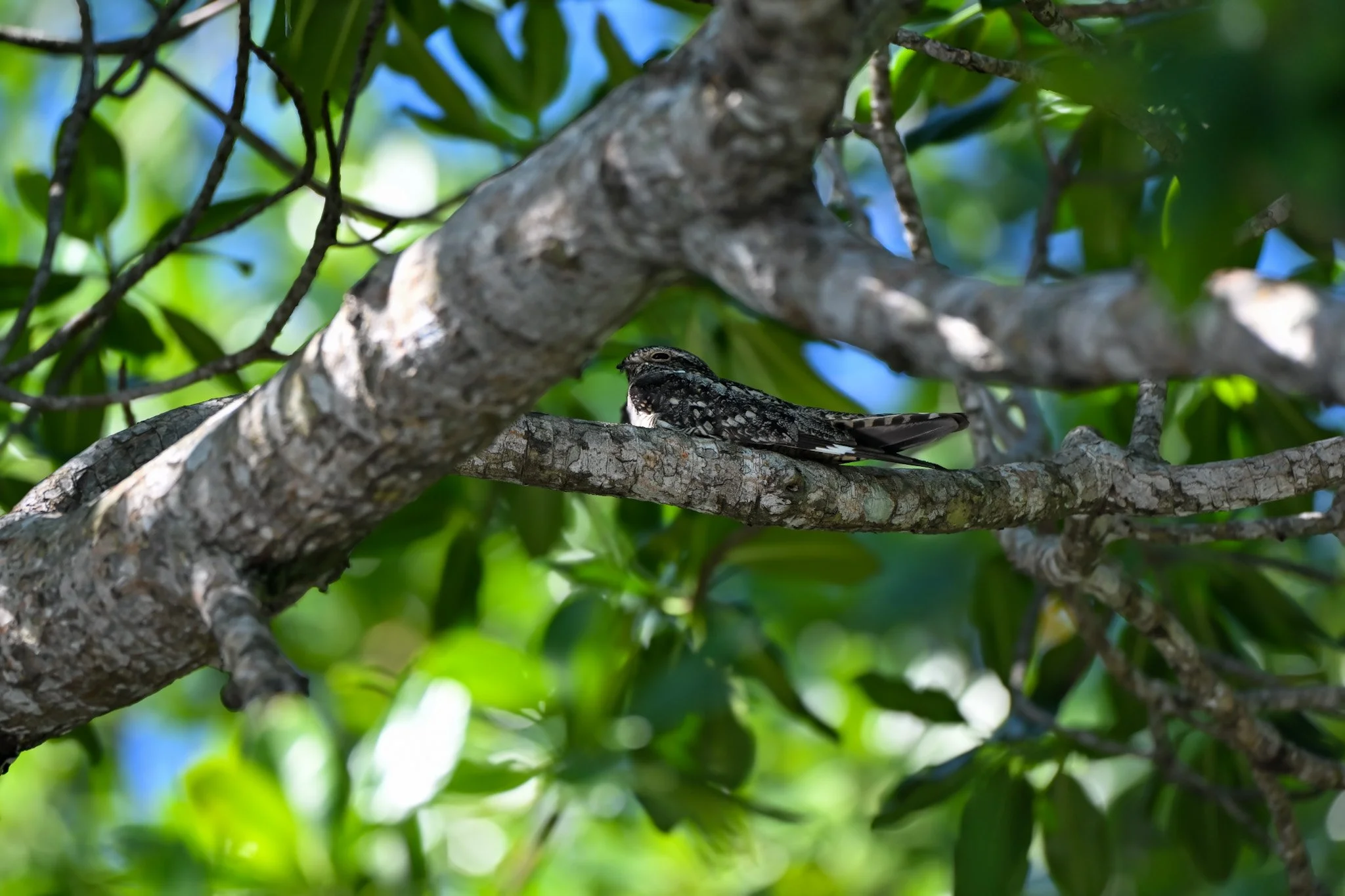
Lesser Nightjar by Mary Bertischi
During our trip, we visited both new and established sanctuaries. The established sites painted an exceptional picture of AH success: cohesive signage, accessible infrastructure, well designed trails, and viewing platforms and blinds. This infrastructure enables visitors to learn about birds, experience the landscape, and truly understand the journey of some of our globally migrating birds. The newer sites illustrated additional funding needs such as more accessible roads to reach their properties, trail design improvements, educational signs, and kiosks.
Our 8-day tour was led by an exceptional guide, Isis Castro. A former board member of Aves Honduras, Isis now directs her own company, Choose Honduras. In addition to her great depth of ornithological knowledge and experience, her contagious energy, commitment to support communities, and flawless organization made the trip an absolute pleasure. It was an enriching and authentic experience that overcame any occasional hardship associated with traveling cross-country in a poor Central American country.
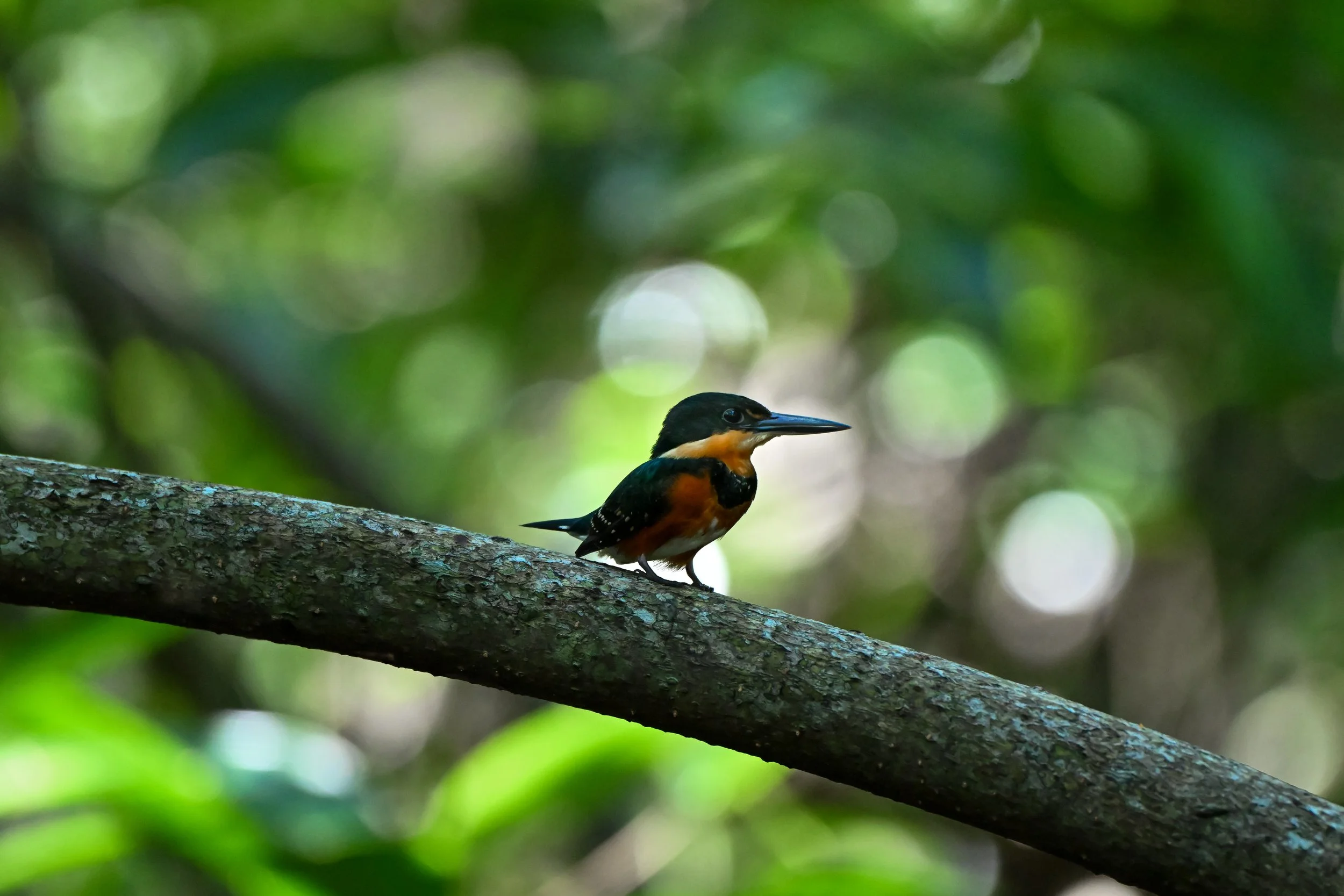
American Pygmy Kingfisher by Mary Bertischi
At the end of the tour, we met with Oliver Komar, Board President and Professor of Ecology and Natural Resources Management at Zamorano University in Honduras to discuss the parameters of a potential partnership. He is an ornithologist and co-author of the Peterson Field Guide to Birds of Northern Central America who specializes in wildlife management. His Aves Honduras team joined us for a dinner and discussion hosted at the Kellogg Zamorano Center. The hospitality and commitment of his team was inspiring. Aves Honduras encourages other NFAS members, and other local Audubon Societies to tour Honduras. We highly recommend this unique and meaningful experience.
Lessons Learned
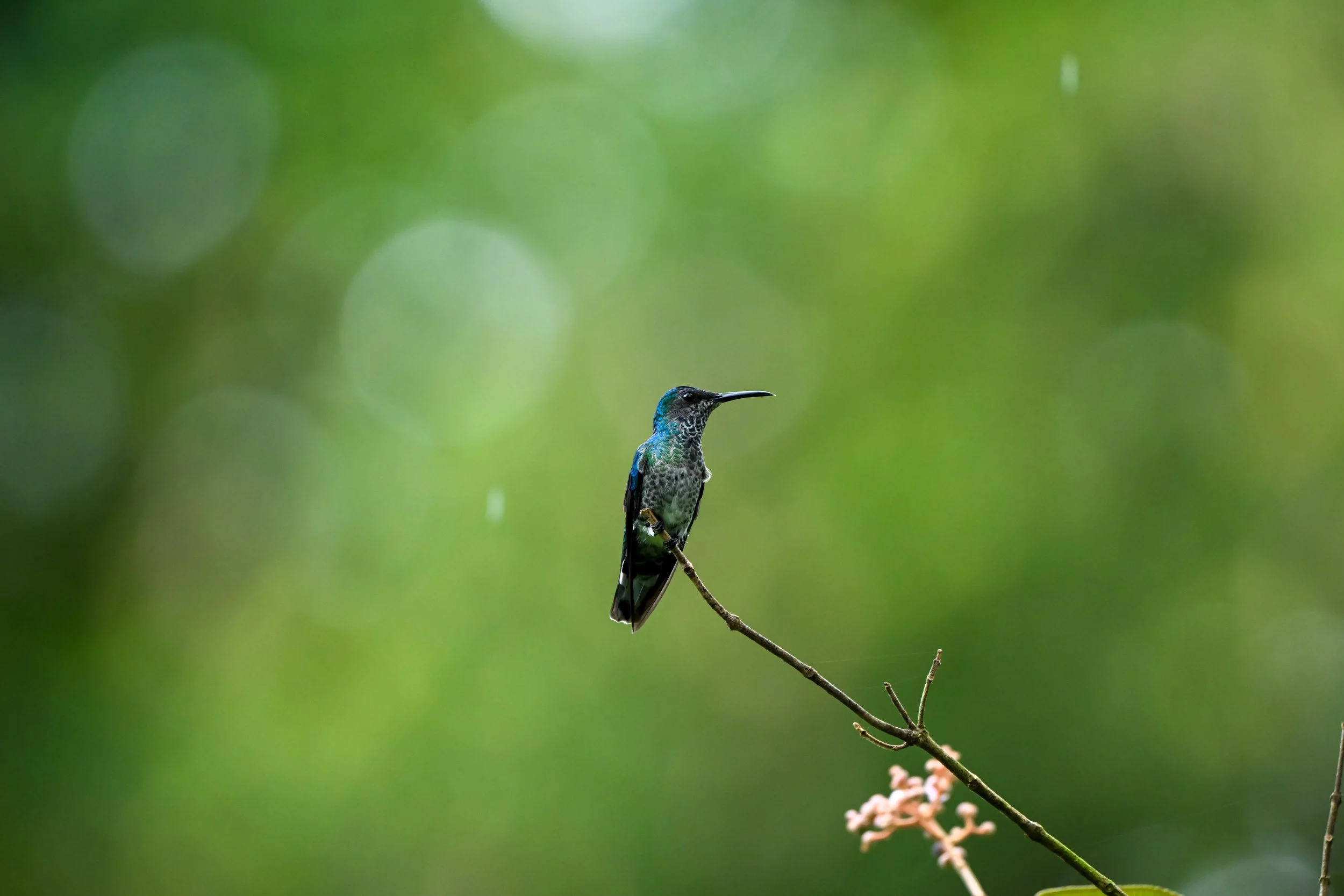
White-Necked Jacobin by Mary Bertischi
Important insights emerged during visits to the sanctuaries. Many of the trails and visitor facilities we used while exploring the properties had originally been designed either through projects funded by USAID or by local conservation professionals who had received training through programs connected to the United States Forest Service (most likely funded by USAID). These earlier initiatives helped establish strong foundations for protected areas, including trail design, land stewardship practices, and visitor management.
However, it also became clear that while these early investments successfully built capacity and infrastructure, there is now a gap in funding for maintaining, updating, and expanding these systems, as USAID has shut down as of July 1, 2025. Many sanctuaries continue to rely on trail networks and design principles that originated from those programs, yet resources for upkeep and improvements are limited.
This experience illustrated how international collaboration can evolve over time. Early government-supported initiatives helped develop the expertise and initial infrastructure that made some of these sanctuaries possible. Today, partnerships between organizations, such as this sistership between our organization and Aves Honduras, can help sustain and build upon that foundation.
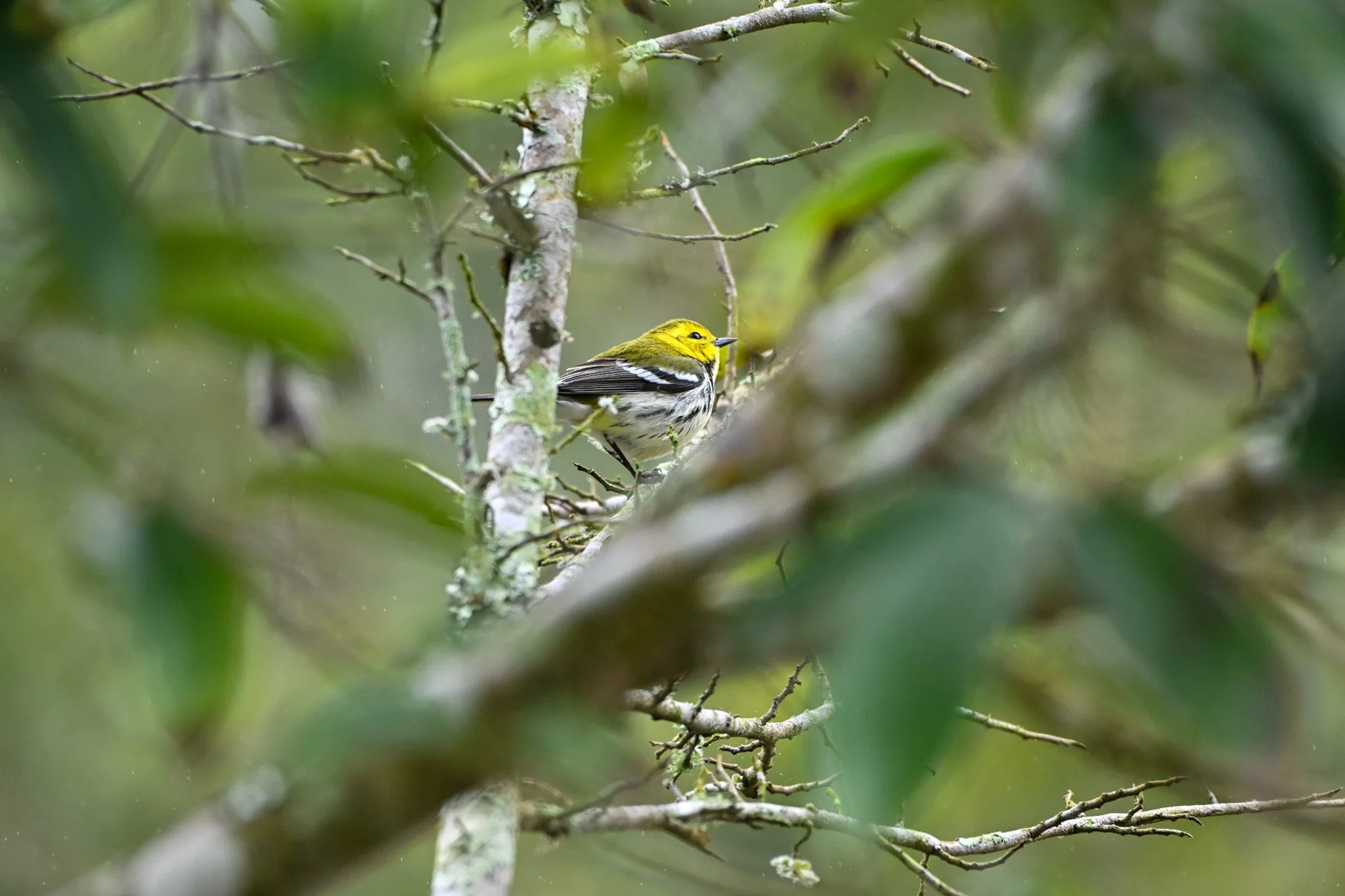
Black-throated Green Warbler by Mary Bertischi
By supporting trail improvements, visitor infrastructure, and educational resources, these collaborations help ensure that protected landscapes remain accessible, well-managed, and valued by the communities around them. In doing so, they strengthen the long-term protection of habitats that migratory birds depend on throughout their annual journeys.
We will be showcasing Mary’s photos at our upcoming Annual General Meeting on June 2nd. This special event is open to members only, if you aren’t a member yet, click here to join!
Welcome to the Berries for Birds Garden
By Robin Simmen
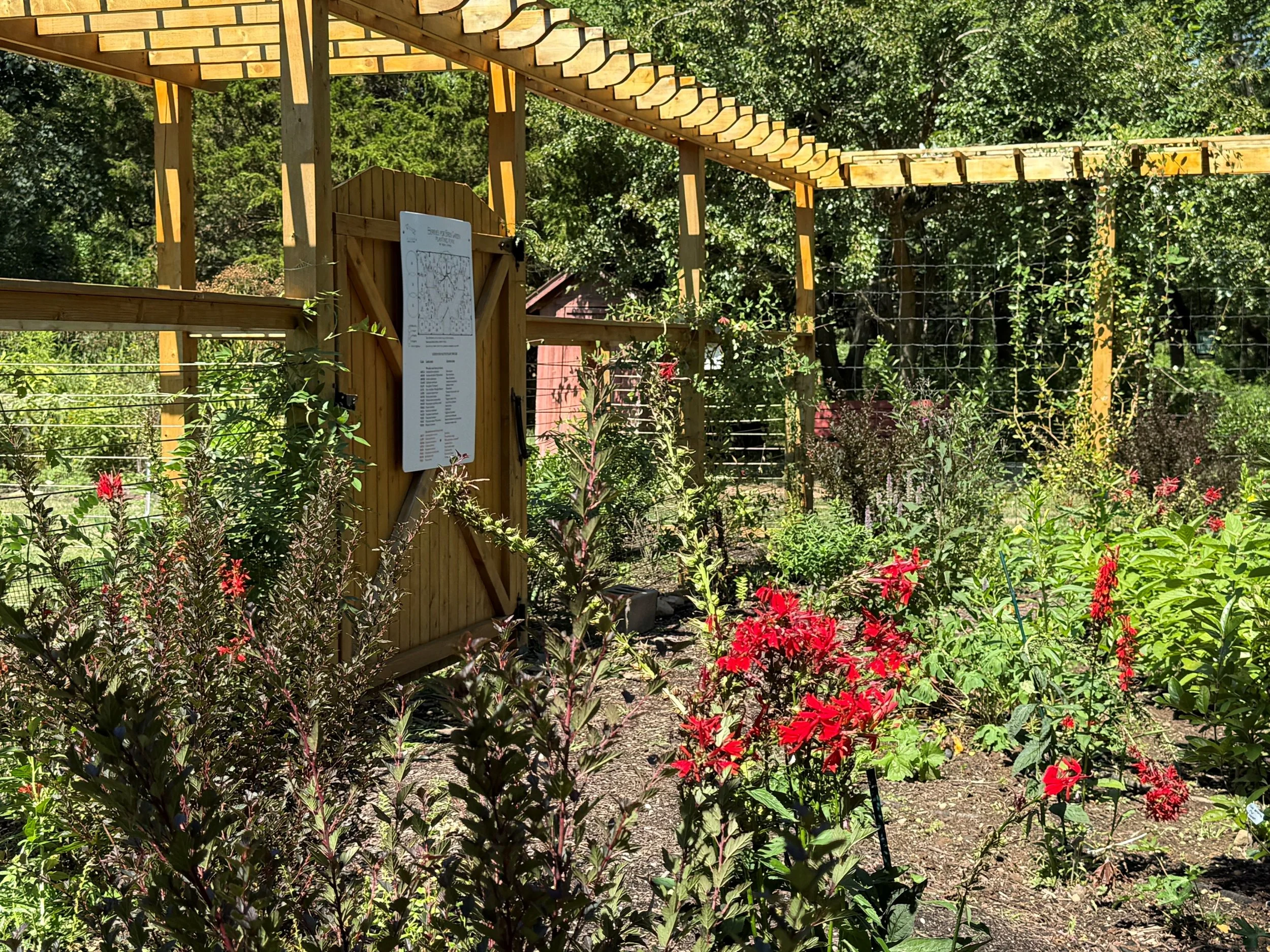
Gardening for the birds is coming into vogue, and not a moment too soon. Birds depend on a variety of nutritious foods to survive. In the spring and summer, they mainly eat high-protein caterpillars and insects to feed their young, while some species, such as hummingbirds, sip on nectar. In the fall and winter, their diets change, and berries, seeds, and nuts are essential to their survival. Bird migration research documents a significant decline in the number of migrating birds, and habitat loss is a major factor.
Our new Berries for Birds Garden in Inlet Pond County Park showcases berrying trees and shrubs, native to the North Fork, that feed migrating and overwintering birds. This demonstration garden also includes native groundcovers, forbs, and seed-bearing plants that support birds during the growing season, enclosed by a custom-built deer fence, designed to be easy to replicate. When you push open the self-closing gate and walk inside, you’ll find 24 species of native plants, labelled with their common and scientific names, so you can identify them and shop for them at our Native Plant sales or at local nurseries. Chairs and small café tables invite you to sit down, drink coffee, relax, and enjoy the birds.
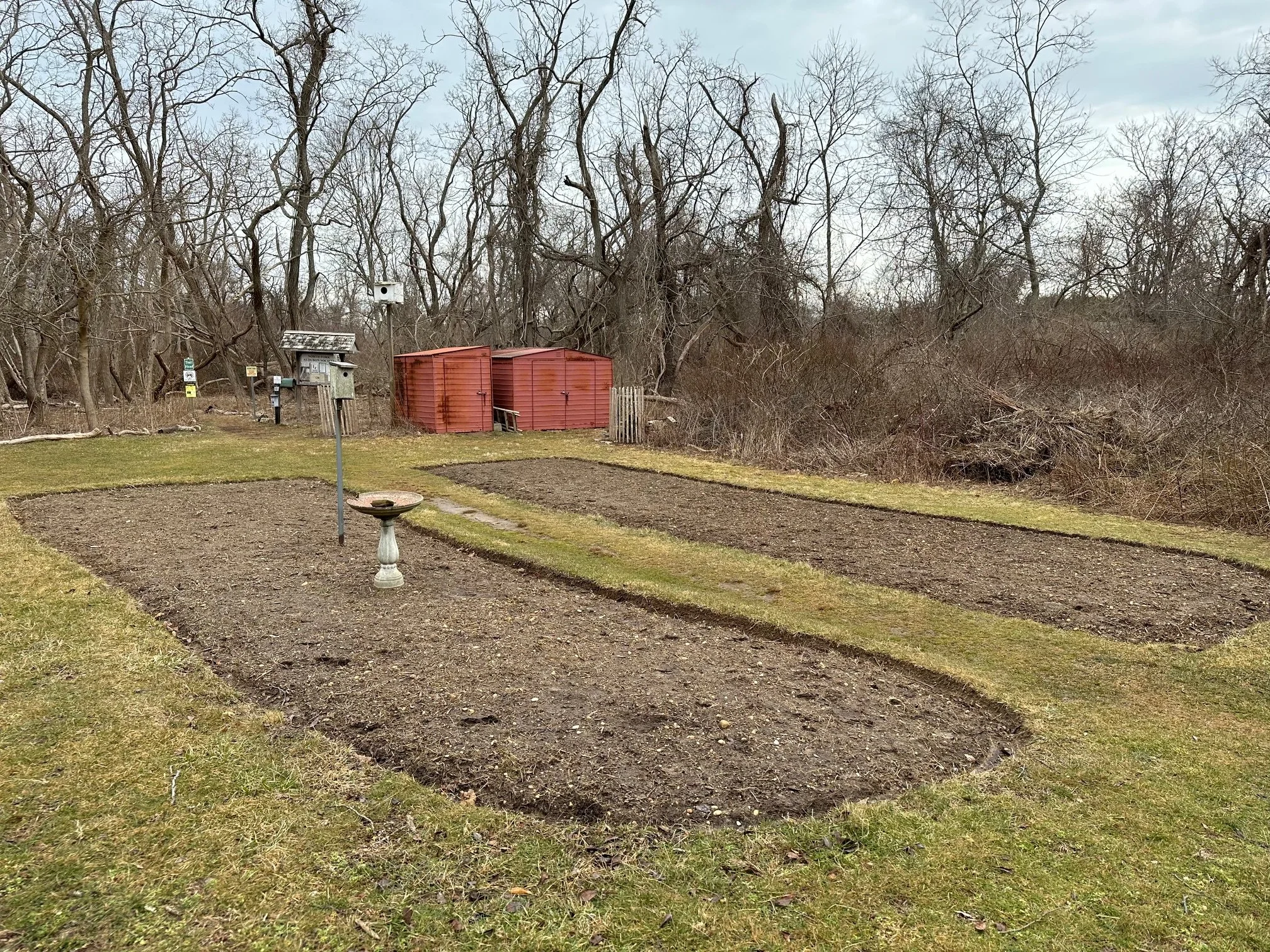
Former site of Butterfly Garden , cleared in 2023 for Berries for Birds Garden
The birth of this garden was a silver lining of the recent pandemic, when board member Ellen Birenbaum proposed that NFAS launch a new public-education project called “Berries for Birds.” Back then, as chair of the NFAS Landscape Committee, I was trying to figure out what we should do with the old “Butterfly Garden.” That hot mess of mugwort and invasive Buddleia shrubs—a.k.a. butterfly bushes--occupied a thousand square feet just east of the Roy Latham Nature Center. It was planted years ago by well-meaning NFAS volunteers who, like most people, didn’t realize non-native plants aren’t good for birds or the environment. In March 2022, Ellen’s proposal triggered an idea: Let’s replace the Butterfly Garden with a Berries for Birds Garden! Like most healthy landscapes, it then took several years to create, with lots of help from NFAS volunteers Veronica Kaliski, Jeffrey Brothers, Paula Marra, and David Bauer, as well as fellow board members Ellen Birenbaum, Andy Senesac, Carol Edwards, Peggy Lauber, and Margaret Steinbugler.
Because deer heavily browse plant life in Inlet Pond County Park, I knew from the get-go that a deer fence was necessary to protect any berrying shrubs from destruction. So, I designed one that people could build at home, showing two strategies for deer fencing. One is to build walls at least 8 feet tall, or higher than deer can jump. Three of the four sides of the new garden employ this type of 8-foot-tall woven-wire fence, attached to cedar posts. Another strategy is to build two 4-foot-tall fences, spaced 5 feet apart; deer won’t jump the 5 feet between fences. Using this approach, the front side of the garden, facing the Nature Center, is fenced with two open boxes of 4-foot-tall cedar posts and rails, lined with wire cables; the boxes flank a 5-foot-wide garden gate in the middle. The entire garden is topped by a narrow pergola that visually unites the two types of fencing and provides a place for the vines growing up the cedar posts to spread into a nice overstory without creating too much shade.
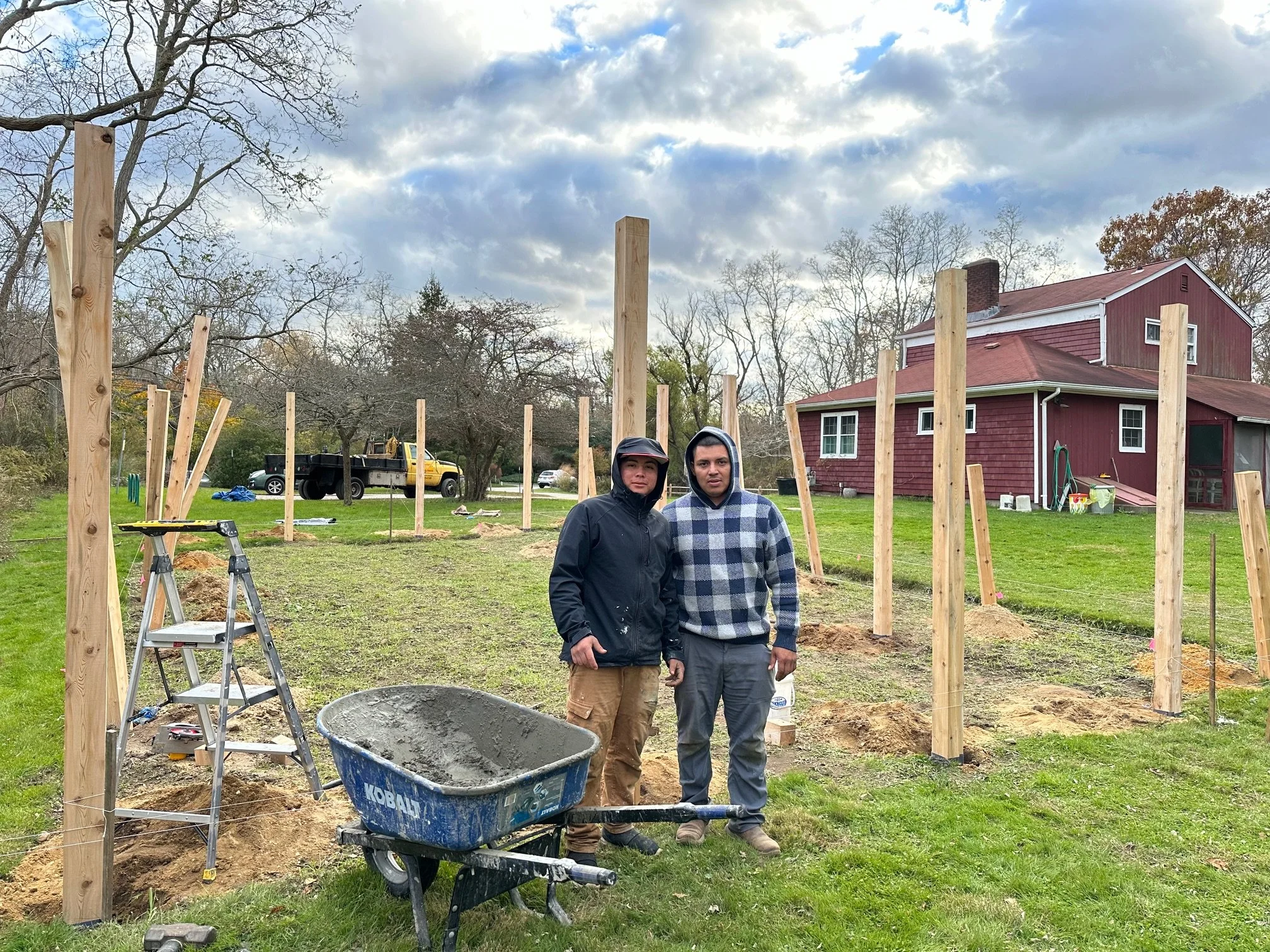
K Luna Fences building the deer fence in 2023
In 2022, NFAS volunteers began the repetitive work of clearing the 1,000-square-foot area (40 x 25 feet) of invasive plant species. Good soil remediation is sometimes overlooked in restoring land for native habitat; if so, the invasive species persist and can overwhelm the best efforts. Growing among the mugwort, butterfly bushes, and European knotweeds we removed were some lovely New York ironwood and goldenrod plants; those were dug up and transplanted elsewhere in the park. Between September 2022 and November 2024, volunteers hand-weeded and weed-whacked the area many times; it was also rototilled and planted with oats for weed and erosion control in the spring of 2024, then rototilled a final time before planting.
Meanwhile, former NFAS board member Rick Kedenburg donated $5,000 toward the cost of the fence construction, and we began interviewing contractors and getting estimates. Edgar Luna of K Luna Fences was awarded the project. He was the ideal builder for the deer fence, solving problems we hadn’t anticipated: for example, he suggested providing access to the two 4-foot-tall boxes by installing invisible swinging doors into them on the side fences. After we received project approval from Suffolk County, Edgar built the fence in September 2023; he stained the cedar in May 2024.
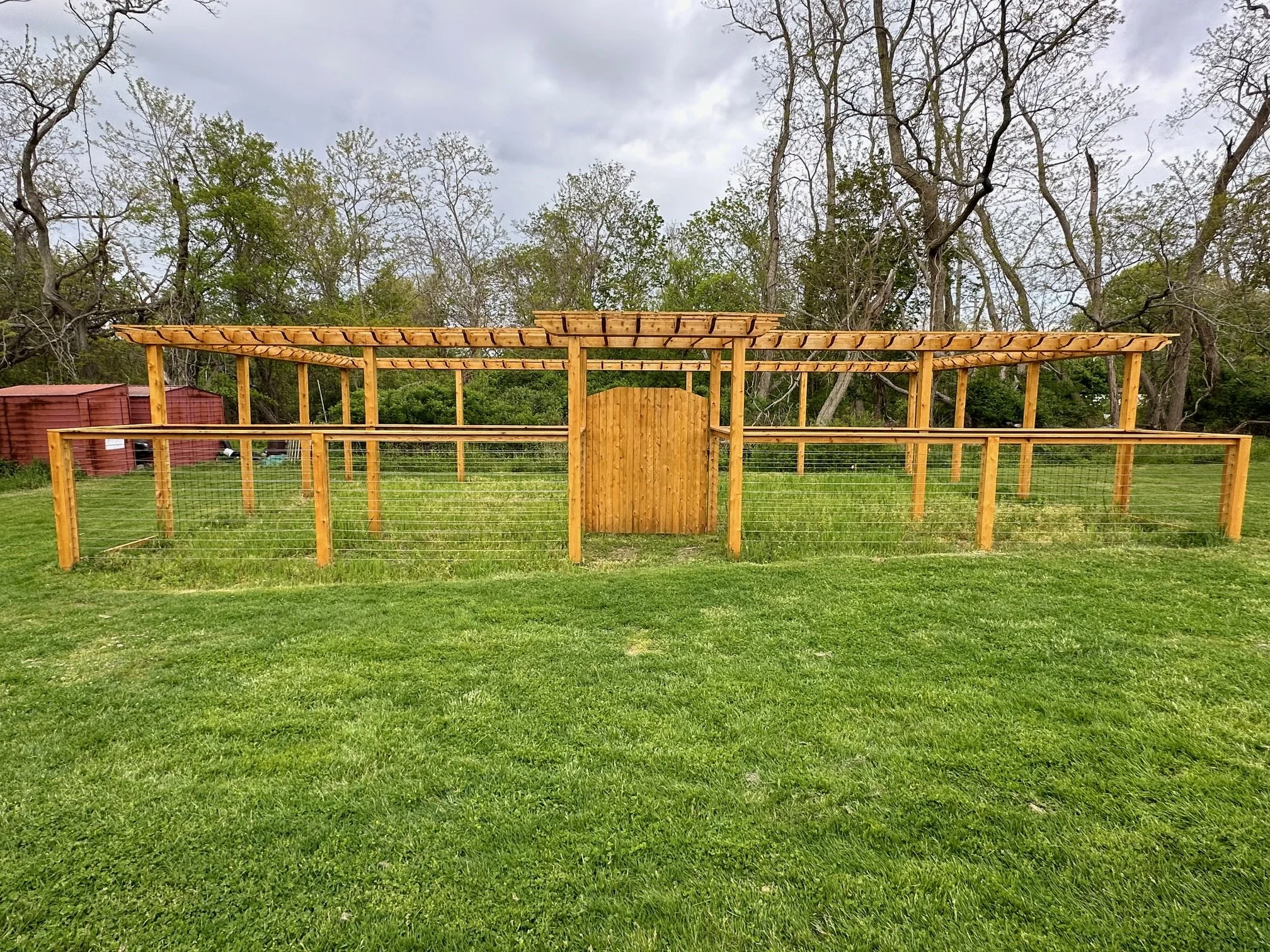
The stained fence May 2024
Choosing native species and arranging the plants and paths in this rectangular garden was serious fun for me. As a landscape designer, I studied native plants at the Conway School of Landscape Design, where in 2001, I received a Master of Science in Ecological Design. Designing a public garden to demonstrate native plant habitat for birds felt like a dream come true!
Doing informal charettes with the NFAS Landscape Committee produced a list of criteria for the form and function of the Berries for Birds Garden. We wanted it to be a welcoming public space as well as a special private place--kind of like an adult fort in the woods--where people could birdwatch, observe the plants, and kick back a little. Maybe meet friends for lunch, bring the kids to see what’s blooming and marvel at the hummingbirds! We decided the garden should be wheelchair-accessible and include comfortable, portable seating, hence the big gate, wide level paths, and café tables and chairs. The gate swings open onto an empty landing area, with two wood-chip paths curving diagonally toward the distant corners; this organic shape helps break up the big box feeling of the fence.
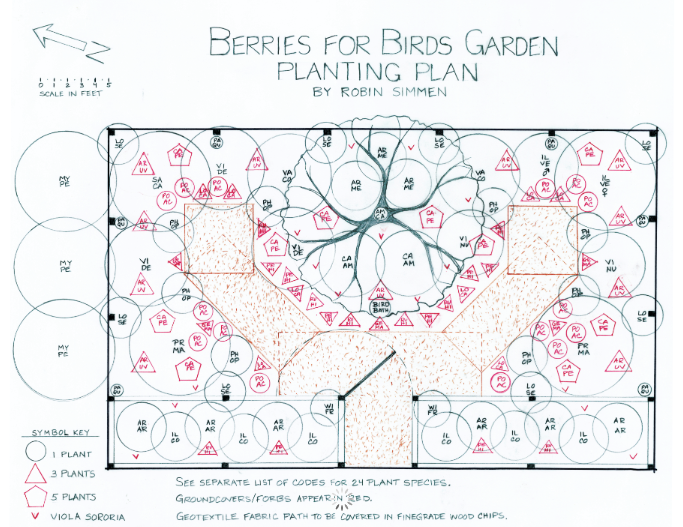
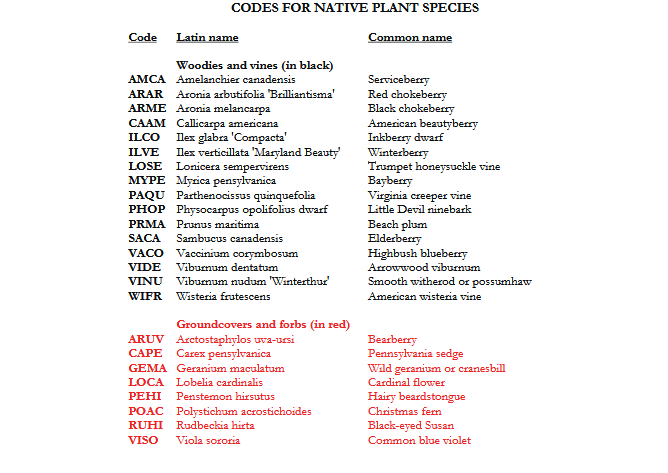
Inputting our zip code into the National Audubon Native Plants database (available on their website, https://www.audubon.org/native-plants/best-results?zipcode=11944) helped me select native plants known to support local birds. Sixteen species of native berrying shrubs, trees and vines are planted in our garden, including both male and female of dioecious species, such as winterberry (Ilex verticillata). Eight species of groundcovers and forbs add texture, color, and nesting materials to the lowest layer of the garden. Our “Berries for Birds” brochure, available at the garden, describes the relationships between the plants chosen and the bird species that use them.

Landscape cloth marking paths in B4B garden prior to planting
Making this garden as beautiful as possible was also a top design priority; poorly designed native plant areas lend the fallacy that native plants are just weeds. Year-round, something is always blooming or very colorful here, from the white chokeberry flowers (Aronia arbutifolia) in April to the red winterberries in fall and winter. And the spikes of cardinal flowers, blooming in late summer, are a feast for the eyes--and the hummingbirds.
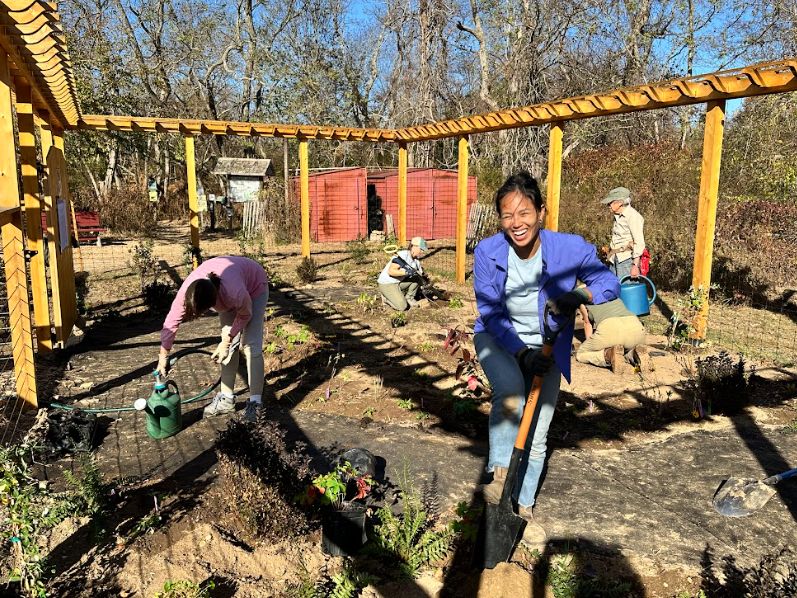
Volunteers Planting B4B Garden November 6, 2024
Sourcing native plant species can be challenging. Many are only sold wholesale to landscapers or aren’t commercially grown. Fortunately, NFAS has long-term relationships with local growers at Glover Perennials and Long Island Native Plants; many of the shrubs and trees in the garden came from them. We also received a community grant of beautiful plant material from ReWild Long Island, tailored to our design specifications, as well as lots of help from ReWild staff and volunteers on planting day.

NFAS Board members after planting B4B Garden Nov 6, 2024
After more than two years of site preparation, the area was ready for planting. The decision to plant it in late autumn was intentional, as that is the best time to plant most native species. This may seem counterintuitive, but consider how hot and dry our summers are, the opposite of what newly planted nurslings need to thrive. Cool, rainy autumn and winter weather gives plants a chance to focus on growing their roots instead of struggling to produce leaves, flowers and fruits. Establishing strong root systems is the most important work for new transplants. Autumn planting gives plants a good eight months to dig in before the blast of summer heat hits them the following year, greatly increasing their survival rates and ensuring good growth in the future.
On November 6, 2024, about twenty volunteers planted the garden on a beautiful sunny day with lots of laughter and celebration. More than 260 plants went into the ground, from small sedges to beach plum trees. Afterwards, we set up a sprinkler system to water them for a few weeks before the big rains set in; then they were on their own.
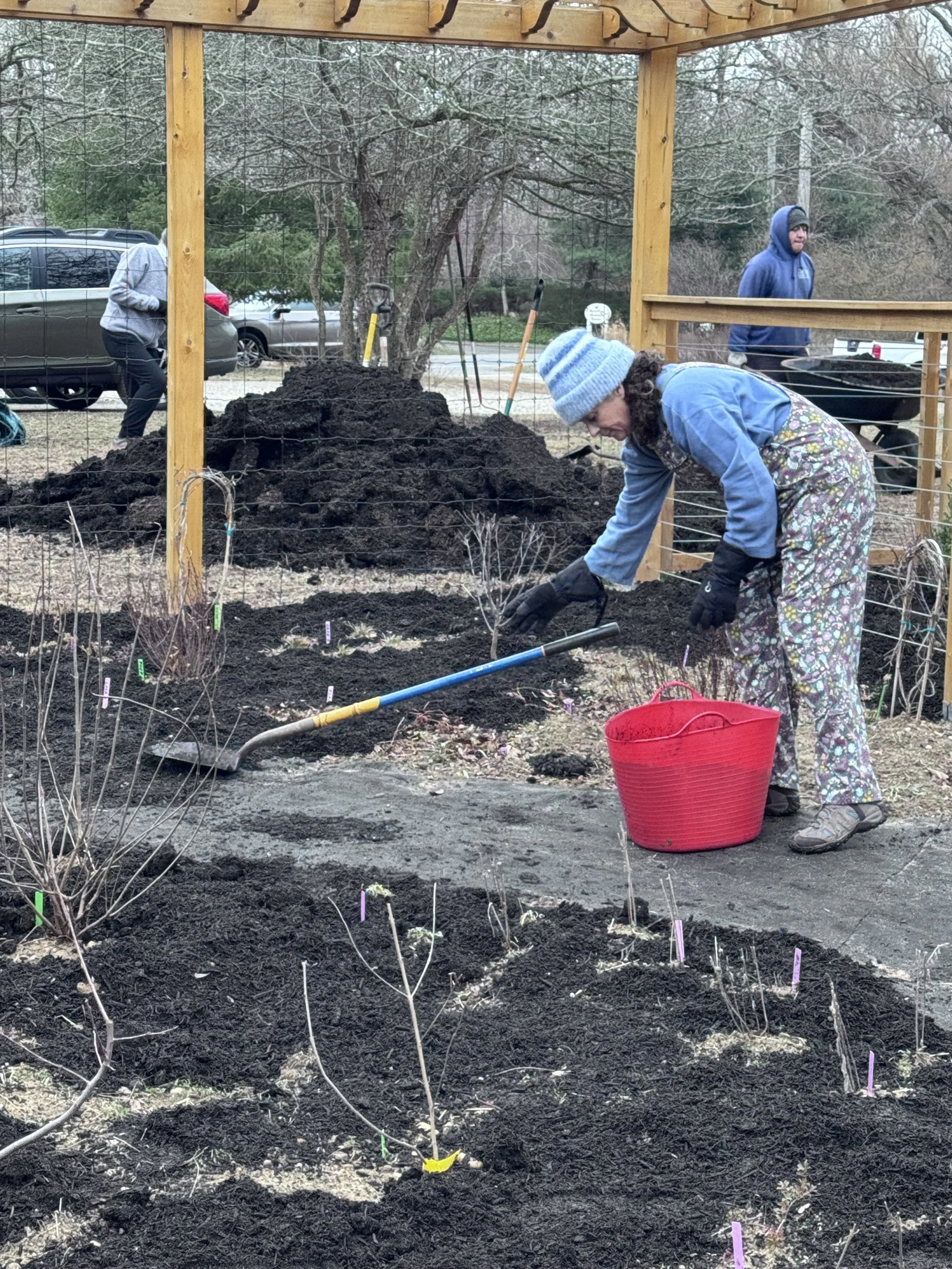
Mulching B4B garden in January 2025
In January 2025, after the ground froze, volunteers spread a thin layer of wood chips across the planting beds. Mulching native plant gardens just once after planting serves many purposes. First, it helps insulate fragile plants from deep cold and subsequent frost heave. Second, it protects bare soil from erosion during heavy spring rains. Finally, when the soil warms up, mulch reduces weed seed germination by blocking sunlight and prevents rapid dehydration during blazing-hot summers. And there’s no need to mulch again—fallen leaves take over after the first growing season.
In May 2025, David and I dug a shallow trench to bury a hose out to the garden to hook up a drip irrigation system of soaker hoses, which we then laid around the plants on top of the soil. Drip irrigation is a water-wise approach to keeping plants alive in the furnace of climate change, providing them with a deep soak to the roots instead of watering the leaves. Our system is run by a timer attached to a spigot that soaks the garden for a couple of hours, two or three times a week, depending on the heat. Over time, hoses lying on the soil are covered by fallen leaves, but they are easy to find and repair if they break. Last November, Andy disconnected the system and blew out the delivery hose with air to keep it from freezing and bursting underground. After a few years of maturity, the native plants hopefully won’t need much water support from us; fingers crossed.
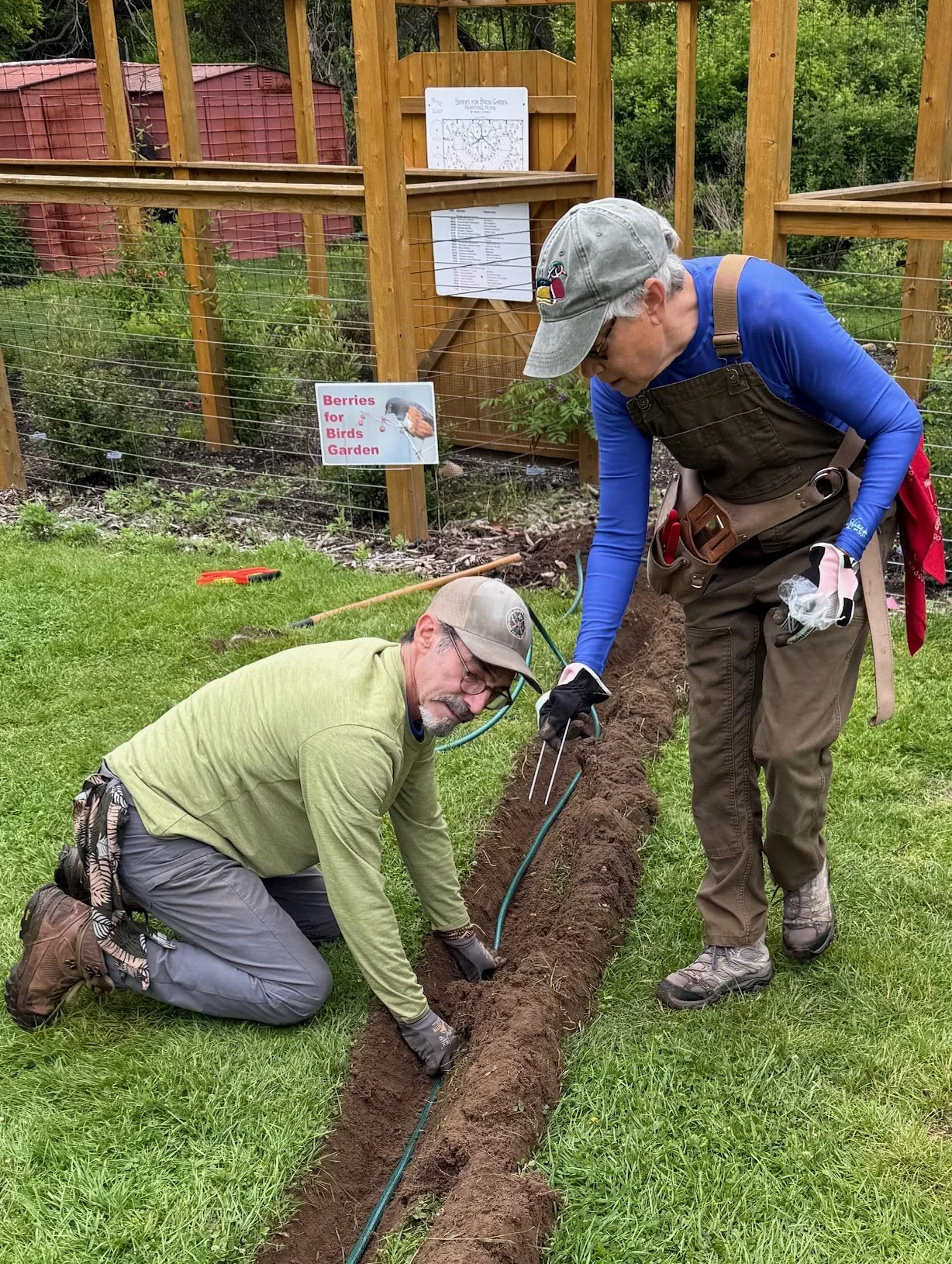
David Bauer and Ellen Birenbaum installing a hose for drip irrigation
Planting every garden is an ongoing lesson in what works and what doesn’t, which is why I love gardening—I’m always learning! For example, I was too optimistic thinking that a serviceberry (Amelanchier canadensis) could be the showy centerpiece of the large bed in the middle of the garden. This beautiful, spring-blooming tree is highly susceptible to rust-fungal diseases hosted by Eastern red cedar trees, which grow throughout the park. Sure enough, the sapling we planted quickly succumbed to the fungus. It has since been replaced with a stately sweetbay magnolia (Magnolia virginiana), which is, in many ways, a better choice. Sweetbay is the only magnolia tree native to the East End of Long Island, and it hosts up to 21 species of moths and butterflies, making it a great source of caterpillars to feed nestlings. Its bright red fruits provide seeds from July to October for woodpeckers, tanagers, grosbeaks, cardinals, and finches. Another silver lining!
We also learned that the small tender plants were irresistible to rabbits that, unlike deer, could easily get into the garden. So last year, we added a border of hardware cloth around the base of the inner garden fence. This year, we plan to do the same inside the front boxes after something chewed hard on the inkberries and chokeberries growing there this winter.
In October 2025, the finished garden was formally dedicated in memory of Rick Kedenburg, a longtime NFAS volunteer, board member and donor, who died in March 2023. Rick was my friend, which made the dedication doubly meaningful to me. I can easily imagine him sitting at a table in the garden, his long legs stretched out, his head tilted back in the sun, squinting up to watch a hummingbird drink nectar from the trumpet vines climbing the fence. I hope you’ll stop by the Berries for Birds Garden whenever you visit the park to watch nature’s beauty unfold across every season, take a deep breath, and enjoy the birds.
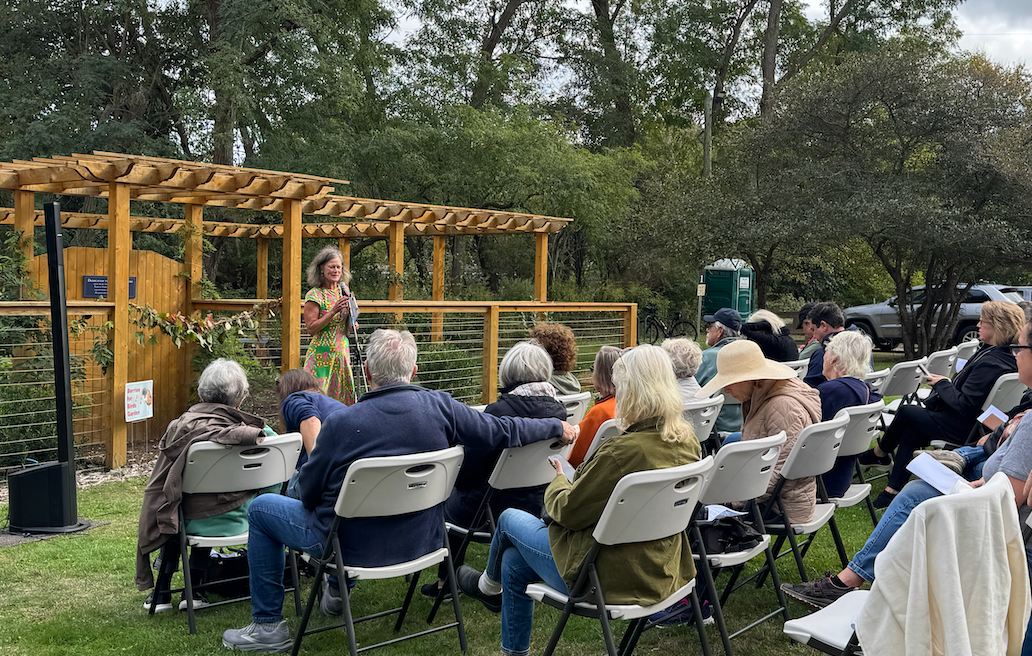
Berries for Birds Dedications, October 2025
The Optimal Time for Hand Weeding Mile-A-Minute Weed
By Andy Senesac, Ph.D
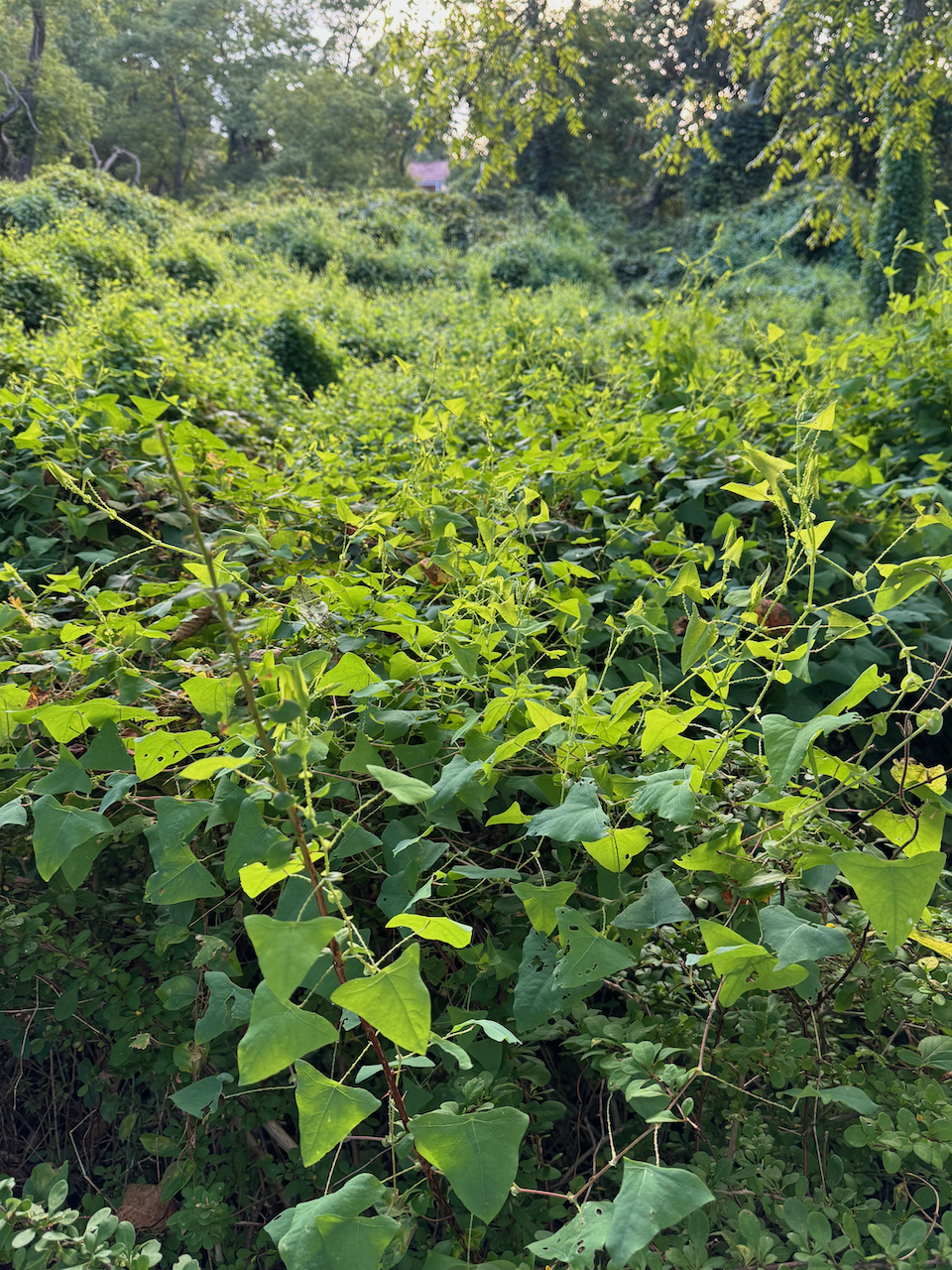
Mile a Minute weed in late August at the IPCP. Photo by A.F. Senesac
Mile-a-minute weed Persicaria persifolia (MAM), a summer annual flowering vine, was unintentionally introduced to eastern Long Island as an invasive species in the late 1990s. Since then, it has continued to re-infest old sites and aggressively invade new areas. It thrives in areas where there is partial shade but can survive in full sun. Several plants have been spotted actually growing in the sand on the beach in different locations. This weed can invade and establish itself in a diversity of environments. It is often found on the edges of homeowner properties near woods and sometimes on the periphery of field nurseries.
Mile-a-minute weed has several commonly used ‘nicknames’: Asiatic tearthumb, climbing tearthumb, and devil's-tail. These describe the sharp downward curved prickles or spines that grow on the stem and petioles. Any attempts to hand pull this weed without heavy leather gloves will really illustrate why ‘tearthumb’ is used to describe it. The spines act like ‘claws’ and allow the vine to easily attach to any nearby vegetation. This adaptation allows it to grow straight towards open areas of the canopy without having to waste energy by twining on other plants for support. This type of rapid upward growth is the reason for the other common name: mile-a-minute. It takes advantage of most of the growing season on Long Island to produce multi-branched, thin-stemmed vines that are loaded with attractive blue fruit. When ripe, the individual shiny black seeds are contained within a fleshy fruit. The fruit are very easily knocked off the vine and are often spread to new sites by migrating birds and other wildlife.
Management options:
Although chemical control can sometimes be practiced on privately owned land, this method has not been possible/practical in most publicly owned wild areas. The use of biological control using mass release of R. latipes (mile-a-minute weevil) has been evaluated and trialed at several locations over the last decade. Developed by Dr. Judy Hough-Goldstein at the University of Delaware, a small weevil (Rhinoncomimus latipes) was found to feed on the leaves and stem without eating other desirable plants. The weevils are released in colonies at the base of the vines and over the course of several weeks, the adults will chew the leaves and lay eggs within the stems of the vines. Despite numerous, and successful, introductions of the biocontrol weevil R. latipes on the east end of Long Island, the weed has simply outstripped the ability of the weevil to control it. The reason for this is simply a matter of too few weevils attacking too much weedy growth. Because of the high cost of introducing the needed number of weevils, managing the weed in this way is not an affordable option at this time.
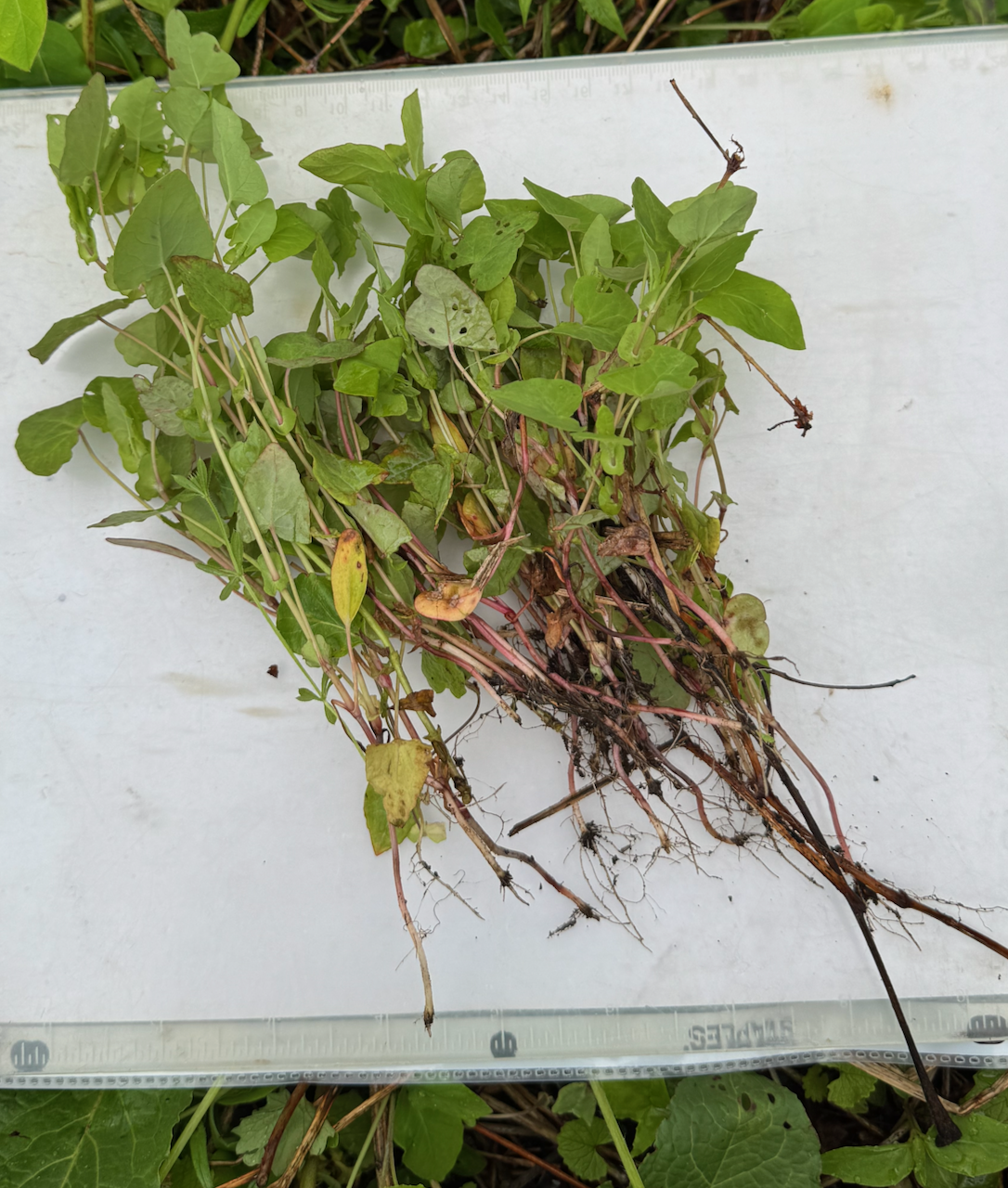
Mile a Minute seedlings removed from a single plot in early May. Photo by A. F. Senesac
Hand pulling: The MAM plants are very weakly rooted and can easily be removed by hand pulling. However, the key question about hand pulling MAM in a large area: is it possible to hand pull once during the season and not have to return for repeat pulls? One of the many unknowns about this weed, is what the critical weed free period is: how long does the area need to be hand weeded before new seedlings stop emerging? This is important because MAM is an annual vine and the seed is thought to be fairly short-lived in the soil (5-7 years). Maintaining a weed free period in the early part of the season may be sufficient to prevent plants growing large enough to produce viable seed in the fall.
In the spring of 2025, a small field trial was established by the author at the Inlet Pond County Park in Greenport, NY. The trial was divided into four replications sited in areas with known high levels of MAM infestation. Each replication, or block, had five treatment areas of 1 square meter each. The treatments consisted of different timings of hand weeding MAM. At the time of weeding each plot, the number of plants was counted and removed.
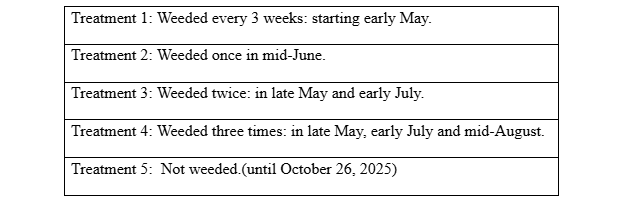
Once the MAM weeds were counted and removed from the plots, any other vegetation was allowed to remain. The control treatment mandated that hand weeding be performed every three weeks. This treatment started on May 6th and continued for 8 more 3-week intervals until October 26, 2025. At this time, the ‘untreated’ control plots were also harvested (for the first time). The results of the trial are presented in the table below:
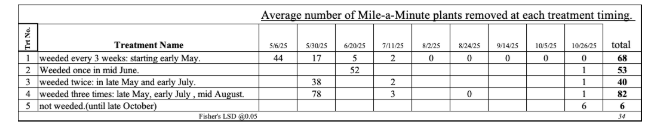
There are several interesting aspects of Mile a Minute growth that were learned during this study. Although the sun exposure was quite different for each of the replications, there were still many seedlings emerging in each replication by mid-April. In treatment 1, the population of emerging seedlings began to be depleted by early July and were absent after that. In treatment 2, only one hand weeding was performed and that yielded an average of 52 plants in mid June. After that, there was almost no further MAM emergence. In treatments 3 and 4, there were high numbers of MAM plants removed in late May, but very few in the subsequent removal timings. Interestingly, the plots in treatment 5 had only an average of 6 MAM plants by the end of the season. This is most likely due to a common phenomenon known as self-thinning. Over the course of the growing season, plants of an annual species such as MAM will often start out with high numbers, but these numbers will be reduced during the season as the most vigorous plants out compete and shade out weaker sibling plants.
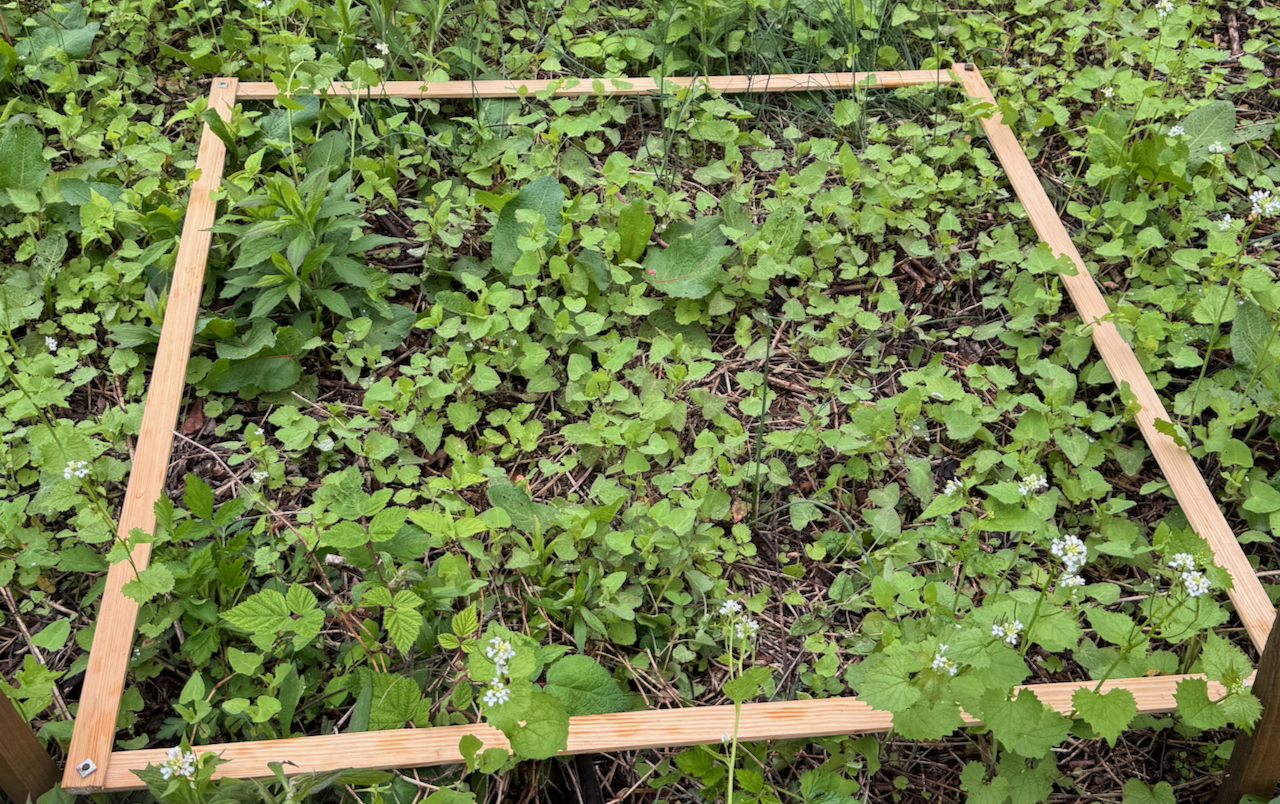
Mile a Minute seedlings growing within a square meter plot in early May. Photo by A. F. Senesac
Based on these results, it appears that a single hand weeding performed sometime during the month of June will be sufficient to remove most of the MAM population that will be germinating. One might ask, why not wait until July or August to perform the hand weeding? The answer is that by waiting, the MAM plants will begin to flower and start seed production. Because the ripened fruits are so easily dislodged, it is not recommended to hand pull the vines after fruit begin to form in late July. Recent research has shown that even immature green fruits can eventually mature off the vine to produce viable seeds for re-infestation . Also, the plants themselves are very large and rank by the later part of the season, so removing them earlier is an easier task. If mature plants are hand pulled after late July, the vines should not be placed directly into composts or other areas where the viable seeds can remain a threat. The pulled vines should be placed under a tarp or landscape fabric until the fruit is no longer viable.
Looking forward to the 2026 season, we will attempt to validate these findings with much larger infestations-tracking any subsequent MAM emergence after a single hand weeding event in June. This article was also published in: Agricultural News:Cornell Cooperative Extension of Suffolk Co.: Vol. 110 No. 1 Spring, 2026.
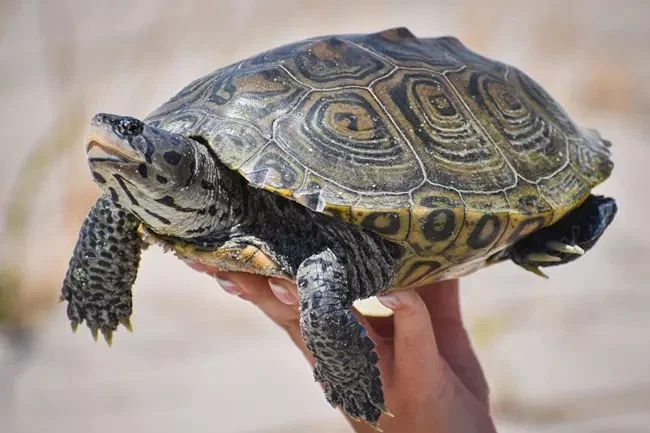
Photo: Karissa Hough Monmouth University
Tracking Terrapins - "Seatuck's Terrapin Watch"
By John Turner
As you read this, diamondback terrapins are sound asleep, buried in sand and mud at the bottom of many North Fork tidal creeks and bays. Here, under many feet of water, and inches of sediment, these air breathing animals respire very slowly, being able to extract enough dissolved oxygen from the water column to stay alive. But soon, as the weather warms, this fascinating and beautiful turtle will emerge, first visible floating at the surface, their heads like little corks bobbing on the surface. Then, in early June through to late July, female terrapins emerge onto land to seek sandy sites to lay their eggs.
This is where you can help! The Seatuck Environmental Association has developed "Terrapin Watch", an effort in "citizen science" to document the distribution of diamondback terrapins in Long Island's coastal waters. It is an easy way for you to contribute to a better understanding of the geographic range and distribution of this iconic and important species by inputting sightings you've had with terrapins whether they're floating in the water or moving about on land. To access the Watch go to Seatuck's website and click on the "Wildlife Conservation" heading and under "Priority Species" click on Diamondback Terrapins. Here you can read basic aspects about terrapins and the threats they face. If you scroll down you can become a "Diamondback Terrapin Citizen Scientist" by clicking on the box. An informational form will appear that needs to be filled out. Once done, your terrapin sighting will be recorded and you will have helped us better understand the locations where diamondback terrapins occur in Long Island's coastal habitats.
If you have questions about the "Watch" please email Ariele Santos at asantos@seatuck.org or John Turner at jturner@seatuck.org.
Thank you for your participation!
Bird Song Project: A Sculpture Trail
By Colleen McDonough
SAVE THE DATE
Saturday, July 18, 2026 – Opening Presentation – Meet the Artists
10 am - Noon
Inlet Pond County Park, Greenport, NY
Please join us at Inlet Pond County Park for an unforgettable morning featuring original art, artists and music. This event will feature several pieces of original sculpture installed along a section of the Park paths. The opening presentation will feature the artists, who will be stationed at their work along the trail, describing their inspiration and artistic process in creating their works and how they complement the natural beauty of the park. Local musicians will also entertain. This project is a way to bring art to the public on the North Fork in a novel venue, and to encourage community engagement with artists and nature. The exhibition will be up from July 18 through October 11, 2026. The artwork will be curated, installed and maintained by the East End Arts Council.
As we wrap up this issue, we invite you to explore our upcoming programs and events. With migration in full swing, May will feature many bird walks throughout the month to celebrate bird migration to the North Fork. Whether you’re joining a walk, attending a talk, or simply enjoying time outdoors, your participation helps strengthen our shared connection to nature. If you’re not yet a member, consider joining our community to support our work, and for those looking to get more involved, we welcome volunteers of all backgrounds and interests. Thank you for being part of our mission, connecting people to nature.
Here are some featured programs and events happening soon!
April 22nd, 7pm Informing Conservation with Audubon's Migratory Bird Tracking Program, a special zoom presentation with National Audubon Alicia R. Brunner, PhD, Tracking Biologist, Program Manager, Migratory Bird Tracking
May 16th & 17th, 9am-1pm Spring Native Plant Sale
Maygration Walks throughout the month of May
June 2nd Annual General Meeting
July 18th Bird Song Project: A Sculpture Trail
To learn more and register for our programs visit our program page.